
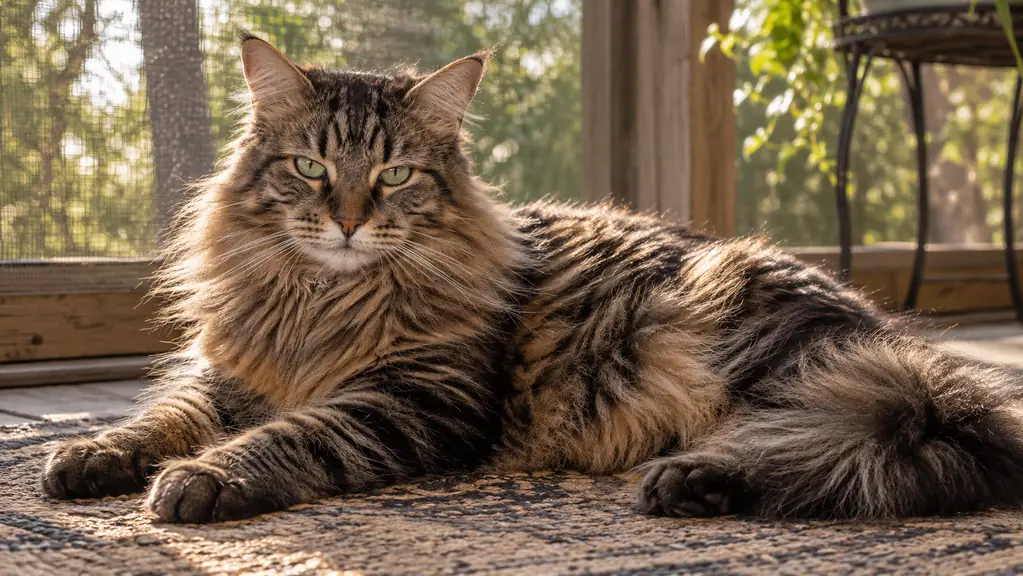
Barnaby is eight years old, eighteen pounds, and built like a small loaf of bread with a tail. He is a brown tabby Maine Coon, and for the first six years I had him I brushed him when the mood struck, which was not often. Then one January I found the knots: two tight, felted lumps tucked behind his back legs, buried in the long feathers he grows there. He flinched when my finger touched one. That was the week grooming stopped being a nice idea and became a chore with a day of the week attached to it.
Here is the thing I wish someone had told me sooner. Mats do not start in the top coat. They start in the loose undercoat, the fine stuff that sheds out and gets trapped against the skin, and once it felts it pulls. So the first tool I reach for is not a mat splitter. It is the FURminator undercoat deShedding tool for medium and large long hair cats, the size made for cats over 4.5 kg with a coat longer than 5 cm. Getting that loose undercoat out is what keeps the felting from starting at all, and FURminator rates the tool at removing up to 90% of it.
Pull the loose undercoat out before it turns into a knot
The FURminator long hair cat tool is sized for cats over 4.5 kg with a coat longer than 5 cm, which is the whole Maine Coon problem in one sentence. I use mine once a week, and twice in spring when the winter coat lets go.
Amazon Check Today's Price on Amazon →Step 1: Read the Coat With Your Hands Before Any Tool Comes Out
Once a week, before I pick up anything, I sit on the floor and go over Barnaby with my fingertips instead of my palms. A palm slides right over a mat. Fingertips stop on it. I start at the shoulders, work back along the spine, then down each flank, and I slow down when I reach the places I already know are trouble.
The five spots I check every single time: behind the back legs, where the britches are longest; under the chin and into the ruff; the armpits, easy to miss and easy to felt; the soft belly; and the base of the tail. On a big cat those areas hold a surprising amount of coat, and they are exactly the places a cat cannot reach to fix on his own.
If everything feels smooth, that is the whole inspection and I let him go. If I find something, I do not panic and I do not reach for the tool yet. A mat that still lifts away from the skin is a combing job. A mat that is flat and hard against the skin is a different problem, and I will get to that in a minute.
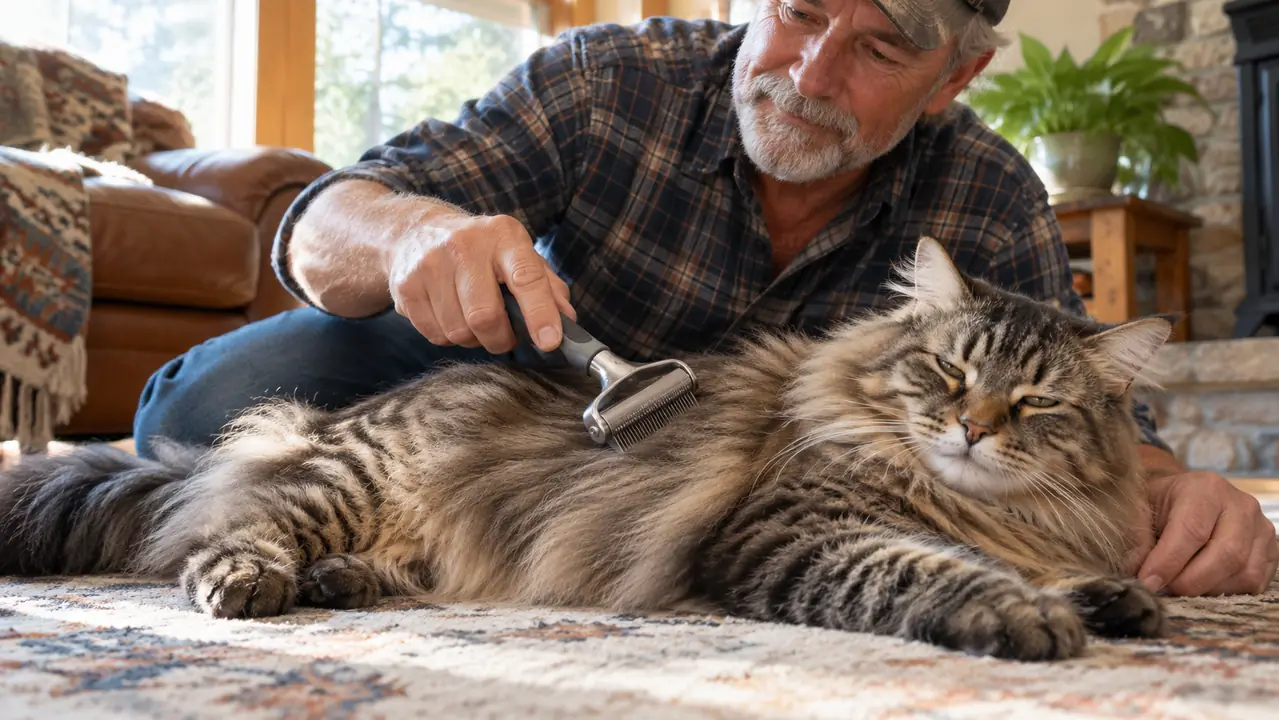
Step 2: Separate the Knot by Hand and Comb Before You Deshed
A felted knot has an outer edge and a hard center. I work the outer edge first, teasing it apart between my thumb and forefinger with small pulls, never yanking from the middle. It takes a couple of minutes and it looks like nothing is happening, and then the knot begins to open and you can see clean skin underneath.
From there I use a wide-toothed metal comb, sliding it under the loosened section and lifting rather than dragging. Comb, lift, comb, lift. The point is to break one mat into smaller pieces that can be combed out, not to rip it free in a single go. Scissors do not come into this house for grooming. One slip near a cat's flank and you are at the vet, and I have heard that story from other people often enough.
If a knot will not give after about five minutes of patient work, or if it sits hard against the skin with no room to get a comb underneath, I stop. That is a groomer or a vet job, and on a cat with a thick coat it is worth the money. Skin under a tight mat gets sore and stays sore for a while.
Step 3: Run the FURminator on Dry Hair, Once or Twice a Week
The directions on the tool are short: dry hair, one to two times a week, ten to twenty minutes a session. I follow that almost exactly. Dry matters. A damp coat clumps and the tool drags, and a cat who gets dragged at once will not stand still for it again. I do this on the living room rug, not on the porch, because Barnaby is calmer indoors and there is less to watch out the screen.
I use light strokes in the direction the coat grows, starting at the shoulders and working back. No pressing. If I have to push to get the tool through, there is a mat in the way and I go back to step two. The FURejector button pushes the collected undercoat off the edge in one press, which sounds like a small thing until you have spent a season picking hair out of a tool with your fingers. The handle is ergonomic and non-slip, which matters more than I expected once my hands get tired.
Ten to twenty minutes is longer than it sounds when a cat is on your lap. I do not do it in one sitting. I do the back and one side, let him walk off, and finish the other side half an hour later. Going over the same patch until the skin looks pink is the most common way people turn a cat off grooming for good.
Two passes down the back and around the britches on a Saturday, and by the next Saturday there is nothing there to felt.
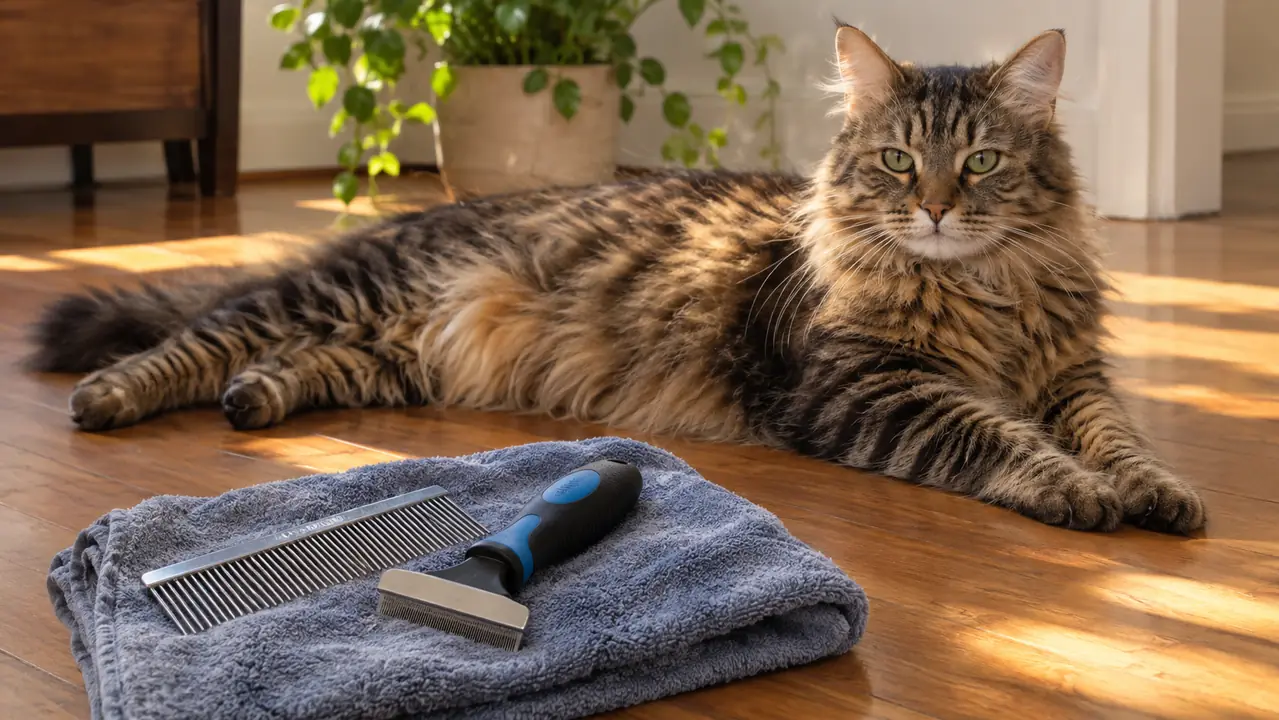
Step 4: Take the Trouble Zones in the Same Order Every Time
Cats like a routine more than they like being brushed. Mine goes in this order: back and flanks first, because that is the easy, pleasant part and it settles him. Then the ruff and chest, working outward from under the chin. Then the britches, which is where the real work is. Then the belly last, quickly, and only if he is still relaxed.
For the britches I use two hands. One hand flat against his hip to steady him and to feel where the skin is, the other hand working the tool in short strokes down the back of the leg. I never pull upward there. The coat feathers downward, and going with it gets the loose material out without tugging at the skin underneath.
When he walks away, the session is over. Not a break, not a coax back with a treat. A cat that leaves has told you he is done, and pushing past that gets you a swat and a cat who hides when he sees the tool come out. There is always next week, and there is always half an hour from now.
Step 5: Put It on the Calendar and Check the Same Two Spots Weekly
My grooming day is Saturday morning, before the grandkids come over, because the house is quiet and I am not rushing. It is on the calendar next to the recycling. Any chore that lives only in my head is a chore I skip, and skipping is what made those knots in the first place. In spring, when the winter coat comes out in handfuls, I add a midweek session and it takes about ten minutes.
That weekly hand check is the part that keeps this from turning into a bigger job. If the two spots behind the back legs feel smooth on Saturday, I have done my work. If they feel slightly rough, I know to slow down and spend more time there instead of waiting for a knot to form. The listing also notes that removing loose hair helps reduce hairballs, and I will say plainly that the hairball end of it improved in this house too.
What Else Helps
The tool is the engine of this, but it is not the whole routine. A wide-toothed metal comb does the work the tool cannot, because the tool removes loose undercoat and a comb finds what is left behind. I keep both in a basket by the sofa so neither one means a walk to another room. If you want the longer version of how the tool has held up, there is a full FURminator cat review on this site.
A second pair of hands makes the britches go faster, and my daughter does that job when she visits. Treats help, but timing matters more than the treat: reward after the session, not during, or you get a cat who nags for the tool and then will not hold still for it. Good light helps too. Half the mats I have missed were missed because I was working in a dim room and could not see the coat part.
And keep the rest of the coat honest. Nails trimmed so he is not catching himself, the ruff combed out a couple of times a week, and porch time watched in damp weather, because a long coat that gets humid and then dries against the skin is where felting starts. If you are still weighing this tool against a slicker brush, the comparison on this site goes through which one does what.
When to Stop and Call the Vet
Some coat problems are not grooming problems. If Barnaby's coat suddenly goes dull or greasy, if he stops grooming himself, if he works at one spot until the skin is bare, or if I lift a mat and find red or broken skin underneath, I call our vet. I am not going to guess at a skin condition on a cat, and neither should anyone reading this.
The same goes for a cat who suddenly will not let you near his back or his hips. That is not a cat being difficult about brushing. That is a cat saying something hurts, and it is worth a phone call. Our vet has been the one to tell me twice that what looked like a grooming problem was something else.
So that is the routine, and it is not complicated: hands first, comb second, tool third, same day every week. Barnaby is eight and a bit stiff getting up on the bed these days, but he has not had a knot behind his back legs in a long while, and he still lines up on Saturday morning because he knows the rug is warm and the session ends.
A mat is one skipped week. This is what stops the next one.
Sized for medium and large long hair cats over 4.5 kg, with a stainless steel working edge and a button that clears the collected coat in one press. Dry hair, once or twice a week, ten to twenty minutes.
Amazon Check Today's Price on Amazon →