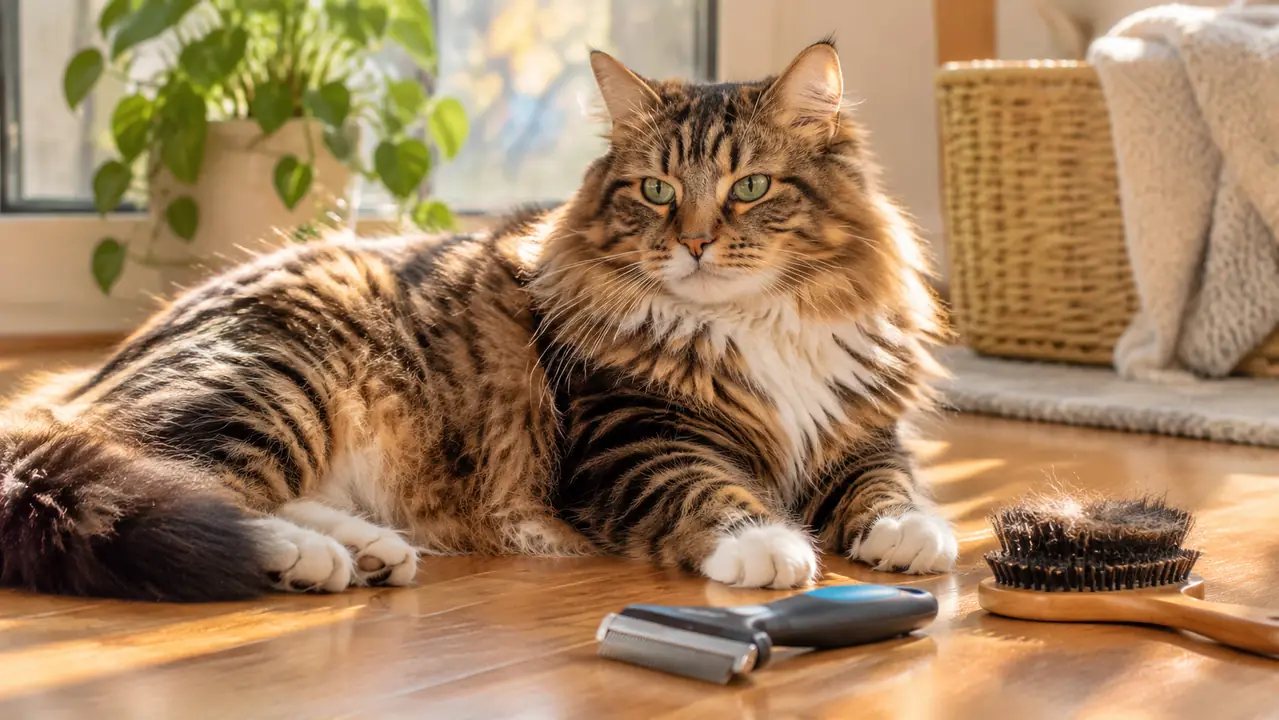
Barnaby is eight, about eighteen pounds, and built like a small freight train with a ruff. His brown tabby coat is long and shaggy, and the britches behind his back legs will felt into a mat if I skip more than a week. For the first year I owned him I used a slicker brush because that is what the pet store shelf offered. It lifted loose hair off the top and made him look tidy. It did not stop the drifts of undercoat along the baseboards. Then I added the FURminator Undercoat deShedding Tool for Medium/Large Long Hair Cats, and I stopped expecting one brush to do two jobs.
The short answer: a slicker brush is the better tool for daily surface grooming, finishing, and working out small tangles. The FURminator is the better tool for pulling loose undercoat out of a thick long coat on a medium or large cat. If you own a Maine Coon, you probably need both, but you do not need them on the same day. I use the FURminator once or twice a week and the slicker brush for quick tidy-ups in between.
The Short Answer in a Table
| FURminator | Slicker brush | |
|---|---|---|
| Best for | Medium and large long-haired cats over 4.5 kg with a thick undercoat | Daily surface grooming and finishing on any coat |
| Coat depth | Reaches the loose undercoat and removes up to 90% of loose hair | Works at the topcoat and surface tangles |
| Mat removal | Not designed to cut mats; go slowly around tangles | Fine pins can work small mats loose |
| Daily touch-ups | Use 1 to 2 times weekly, 10 to 20 minutes per session on dry hair | Can be used daily for a minute or two |
| Cat comfort | The stainless steel tool and FURejector button need a light, deliberate hand | Softer pins are more forgiving on sensitive skin |
| Cleaning | The FURejector button releases hair with ease | Hair lifts from the pins with a comb or your fingers |
| Durability | Stainless steel and an ergonomic, non-slip handle | Pins can bend if dropped or pressed hard |
| Skill needed | Light pressure and short strokes; easy to overdo | More forgiving for a beginner |
| Heavy shedding season | Best when the undercoat is blowing out | Best between sessions and for a tidy finish |
| Ruff and back | Gets under the thick ruff and along the back | Good for the chest and the finish on the sides |
| Britches and small mats | Use with care, it is not a mat splitter | Better for the mats that form behind the back legs |
What a Maine Coon Coat Actually Needs
A Maine Coon coat is not uniform. The ruff is dense, the back is thick, and the britches behind the back legs are where felt starts. A brush that works on a short-haired cat can skate over the top of that coat and leave the undercoat untouched. The coat also changes with the season. In spring Barnaby sheds in handfuls, and in winter the same coat looks smooth until I part it and find a woolly layer underneath.
I learned this the slow way in his second year. I had a slicker brush with fine pins and I used it faithfully every evening for about ten minutes while the news was on. He looked wonderful from across the room. Then one Saturday in April I parted the fur along his spine with two fingers and found a layer of grey wool packed flat against the skin, dense as felt, that had been sitting there all winter. The slicker had been gliding over the top of the coat for months and I had never once seen what was underneath it. That is the moment I stopped judging his coat by how it looked and started judging it by what my fingers found.
That is why the tool matters less than the job. Surface work and undercoat work are different jobs. A slicker brush is built for the surface. The FURminator is built for the undercoat. If you use only one, you will either leave the undercoat behind or you will be too rough on the topcoat.
Barnaby is a medium to large cat at about eighteen pounds, and his coat is well over five centimeters in the ruff. That puts him in the range the FURminator is made for: medium and large long-haired cats over 4.5 kg. A smaller cat with a shorter coat would not need the same tool. A Maine Coon usually does.
Where FURminator Wins
The FURminator wins on undercoat. The listing says it removes up to 90% of loose hair and helps reduce hairballs, and that matches what I see in the wastebasket. After ten minutes along Barnaby's back and ruff, the tool holds a pad of grey fluff that would otherwise end up on the rug or in his stomach. I use it one to two times a week, ten to twenty minutes per session, on dry hair. That is the whole routine.
The design is plain and sturdy. The tool is stainless steel, it has an ergonomic, non-slip handle, and the FURejector button releases the hair with ease. I have arthritis in my thumbs, so the handle matters. I can hold it without squeezing hard. It weighs about 5.7 ounces and measures 1.97 by 5 by 8.82 inches, so it fits in a shallow drawer with the slicker brush and does not take up much room on the coffee table while I work. I can hold it for a full session without my wrist aching afterward. It is not a brush I leave out for a quick pat. It is a tool I sit down with.
It also holds up to a heavy coat. I have used the same tool on Barnaby for years now across several spring blowouts, and the teeth have not bent or dulled. I do not press hard, which helps, but the stainless steel is doing its part. With the slicker brush I have gone through two in the same stretch of time, both because the pins bent after they got knocked off the arm of the couch.
Where a Slicker Brush Wins
A slicker brush wins on the small stuff. It is the tool I reach for when Barnaby has a tangle behind one back leg or when I want him to look tidy before my grandkids arrive on Sunday. The fine pins work through surface tangles without pulling the whole coat. It is also more forgiving on a cat who is touchy about his belly or his tail. Barnaby will tolerate a slicker brush in places where he will walk away from the FURminator.
The slicker brush is also easier to use every day. A minute or two on the chest and sides keeps the topcoat smooth and gives me a chance to feel for mats before they tighten. What it does not do is reach the undercoat. If I use only the slicker for a month, the loose wool stays packed against his skin and the mats get worse. The slicker brush is the finish, not the whole job.
The undercoat tool that earns its shelf space
If your Maine Coon has a thick ruff and leaves fur on every chair, start with the FURminator. Use it on dry hair, once or twice a week, and let the FURejector button do the cleanup.
Amazon See the FURminator on Amazon →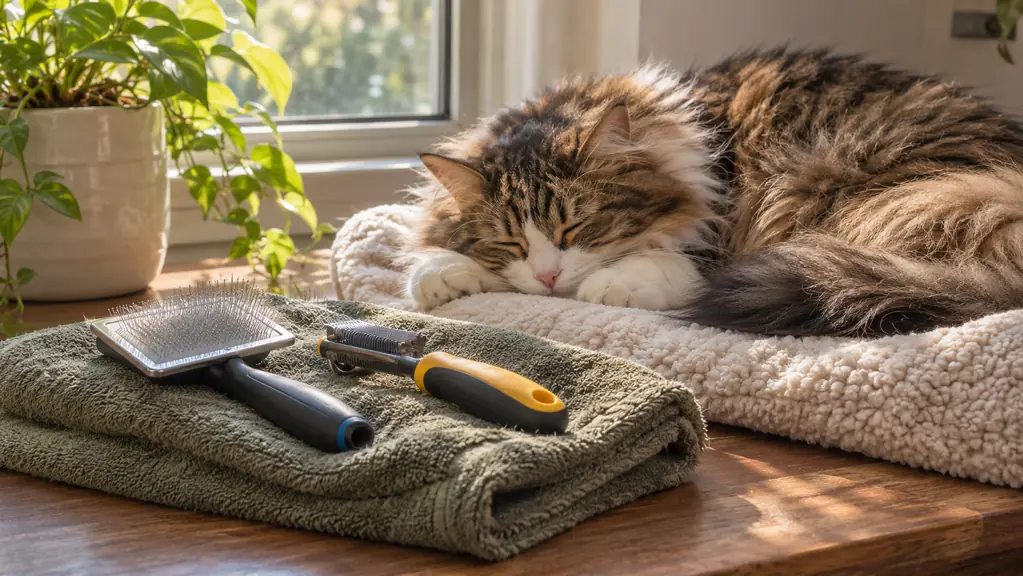
How I Use Both on Barnaby
My routine starts with my hands. I run them over Barnaby's back, down his sides, and behind his back legs. If I find a mat, I do not attack it with the FURminator. I use the slicker brush to work at the edge, a little at a time. If the mat is tight to the skin, I stop and call our vet or a groomer. Pulling on a mat hurts, and a hurt cat remembers.
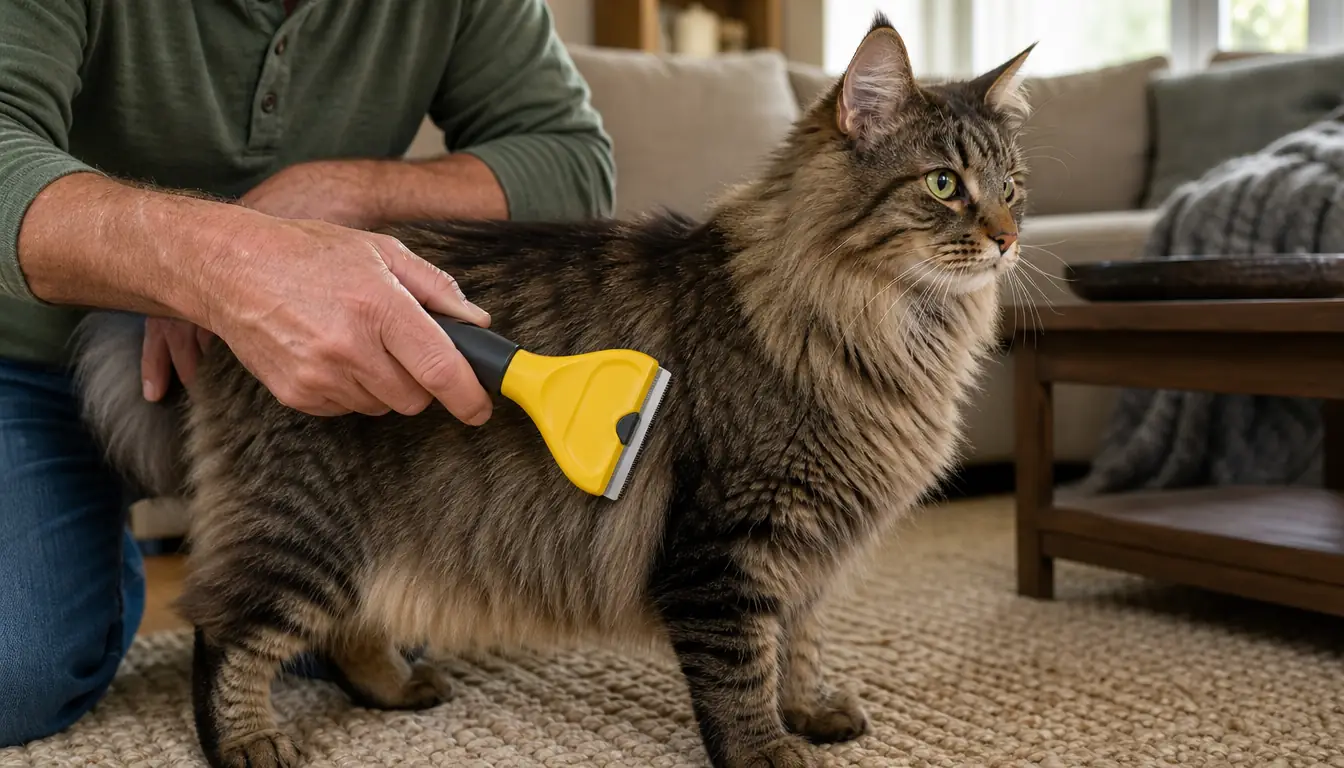
If the coat is clear, I use the FURminator first. Short strokes, light pressure, following the direction of the hair. I go along the back, the ruff, and the sides, then I empty the tool with the FURejector button. I do not press down. The tool does the work. Ten to twenty minutes is plenty. Barnaby starts to fidget after that, and a fidgety cat is how people get scratched.
When I sit down for a session I position him on the kitchen floor with his side against my knee, and I work in small zones rather than trying to do the whole cat. Left side, then a break. Ruff, then a break. Right side, then done. He gets up and walks off somewhere around the fifteen minute mark, and I have learned not to chase him. Finishing early and leaving him willing is worth more than a complete session that ends with him hiding under the bed for an hour.
Then I finish with the slicker brush. It smooths the topcoat and catches the little tufts the FURminator left behind. I clean both tools before they go back in the drawer. The FURminator gets emptied with the button and wiped with a dry cloth. The slicker gets the hair pulled out of the pins with a comb. Dry hair only. A wet coat and a deShedding tool are a bad combination.
The FURminator removes up to 90% of loose hair, but it does not untie a mat. A slicker brush does not reach the undercoat. I need both, and I use them on different days.
The Mistakes I Made First
I made three mistakes at the start. I pressed too hard because I thought more pressure meant more hair. That just made Barnaby flinch and left red marks on his skin. I used the FURminator on a damp coat after a bath. The tool dragged and pulled. Now I wait until he is fully dry, which on a coat that thick takes most of an afternoon. I keep the tool in the drawer until he has stopped grooming himself and the fur along his back feels dry to the back of my hand.
The third mistake was expecting one tool to do everything. I spent a month using only the slicker brush and wondered why the mats behind his back legs kept coming back. The slicker was doing its job. I was asking it to do a job it was not built for. Once I added the FURminator and kept the slicker for finishing, the coat stopped getting ahead of me.
There was a fourth thing, less a mistake than a hard lesson. Barnaby had gotten a mat about the width of my thumb behind his left back leg, close to the skin, and I decided I could work it out with the deShedding tool because I was in a hurry. He yowled and pulled away and would not let me near that leg for a week. The mat did not come out. Our vet dealt with it in about two minutes and told me, kindly, to leave the tight ones to her. Now I use the slicker at the loose edge of a mat and nothing more. If it does not give in a few passes, I stop, and I mean I stop that day, not that I try again in ten minutes.
Who Should Buy Which
Buy the FURminator if you have a medium or large long-haired cat with a thick undercoat, especially one that leaves fur on the furniture and coughs up hairballs. It suits a cat over 4.5 kg with a coat longer than 5 cm. Use it on dry hair, one to two times a week, ten to twenty minutes per session. If your cat is small, short-haired, or hates being handled, this is more tool than you need.
Buy a slicker brush first if your cat is young, sensitive, or new to grooming. It is the easier place to start, and it handles the daily tidy-ups and small tangles. Many Maine Coon owners will end up with both. I would buy the slicker brush first and add the FURminator when the undercoat starts showing up in the corners. That is the order that worked for me, and if I were starting over with Barnaby as a kitten I would do it the same way rather than buying both on the same afternoon.
Start with the tool that gets under the ruff
The FURminator is made for medium and large long-haired cats. If Barnaby's coat is any guide, it will cut down the loose hair and the hairballs, as long as you use it on dry hair and do not press.
Amazon See the FURminator on Amazon →