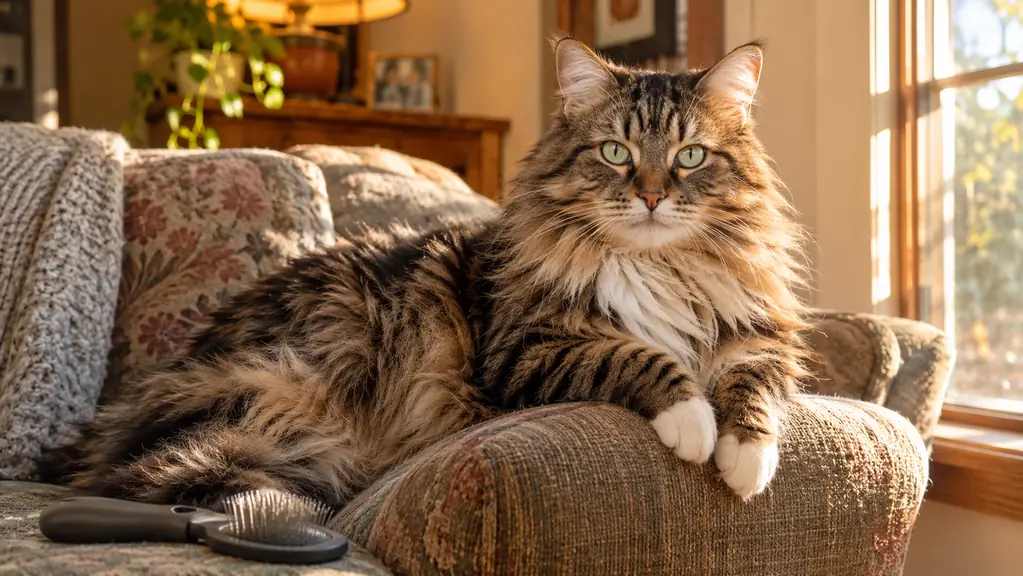
Barnaby is eighteen pounds of brown tabby Maine Coon, eight years old, with a ruff like a winter scarf and britches that mat behind his back legs the moment I let a week slide. For a long time I thought I was keeping up with his coat. Then in February my hand found a mat behind his left thigh that felt like a felted walnut, and I admitted I was not.
That was the week I bought a FURminator undercoat deShedding tool, the medium and large long hair cat version. Not after careful research. A woman in my knitting group keeps two Maine Coons and she said it was the only thing that ever got under her boy's coat. I have now used it several times a week for months, through a spring blowout and a humid Maine summer. Here is what I can tell you without dressing it up.
The Quick Verdict
The only tool I have found that reaches a Maine Coon's undercoat instead of skimming the top of it. Ten to twenty minutes, once or twice a week, and the mats stop forming. It will not cut out a mat that already exists, and it will not work on a cat who will not be handled.
Amazon Check Today's Price →The tool that finally got under Barnaby's ruff
Built for medium and large long hair cats over about four and a half kilos. One to two sessions a week, ten to twenty minutes each, on dry hair. The FURejector button empties the head in a single press.
Amazon Check Today's Price on Amazon →How I've Used It on Barnaby
The package directions say one to two times a week, ten to twenty minutes per session, on dry hair. I have mostly stuck to that. In March, when Barnaby was blowing his winter coat and tufts were drifting across the kitchen floor like weather, I went to three sessions a week for about ten days and then back to two. Wet fur is a waste of your time with this tool, so I brush him after breakfast, not after his bath.
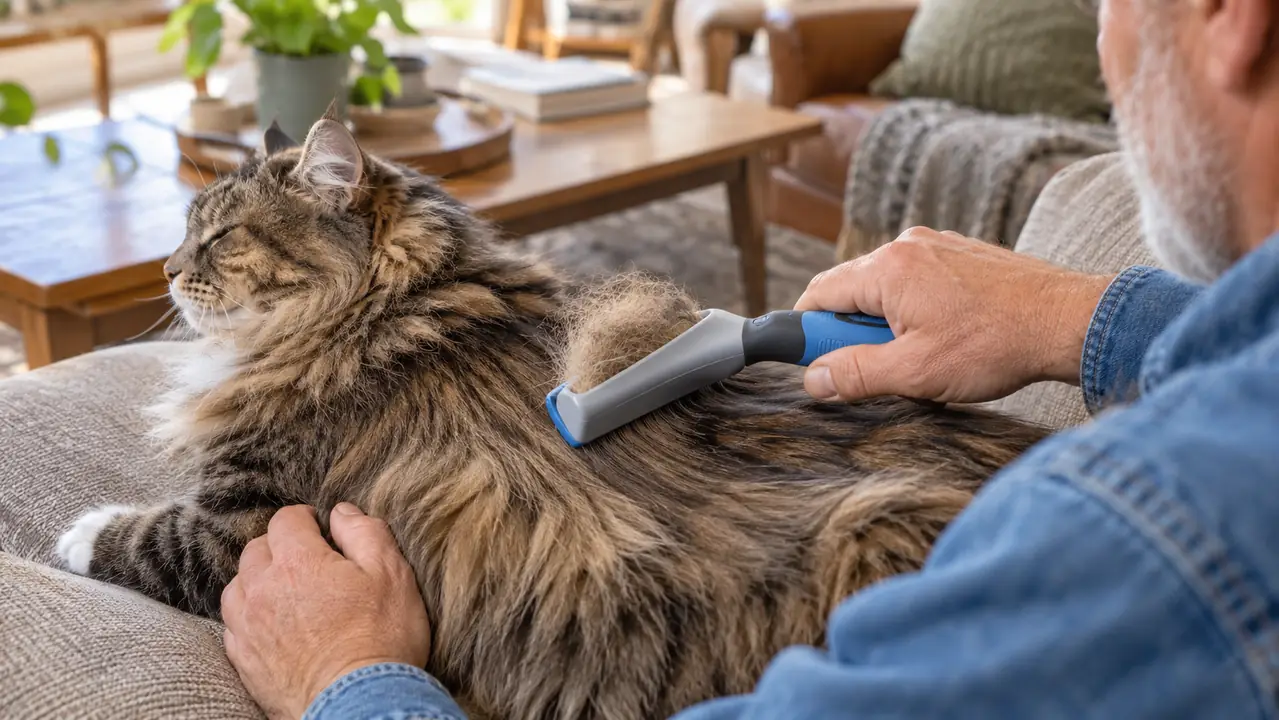
A session has a shape now. He eats, then settles on the arm of the sofa where the sun lands, and I start at his back, working in the direction the hair grows with short, light strokes. The ruff around his neck takes the longest, because the hair there is deep and the undercoat sits close to the skin. The britches behind his back legs take the second longest, because that is where the mats form, and if I catch them early they never get started. He grumbles once when I begin and then purrs for the rest of it, which I take as a fair review.
The FURejector button sits at the back of the head. Every few strokes I hold the tool over the wastebasket and press it, and the collected hair drops out in one piece. That sounds like a small thing. It is the difference between ten minutes of work and ten minutes of work plus five minutes of picking hair out of the teeth with my fingers, and it is the reason the thing lives on the sofa arm instead of in a drawer.
The first session was startling. I filled the wastebasket twice, and Barnaby's coat looked thinner in a way that worried me until I understood that a long-haired cat in February is carrying months of undercoat that never came out. It settled down after a few weeks. Now a session produces a modest handful, which is what you want, because a modest handful means you are keeping up.
Ten minutes covers one side of a cat this size. Twenty minutes covers him properly, which is what the directions suggest and what I now do on the weekends. If I try to do it in five, I skip the ruff and the britches, and those are the two places that matter.
What the Tool Actually Does
The head is stainless steel with fine teeth set at an angle, and it works under the topcoat instead of skimming across it. FURminator says it removes up to ninety percent of the loose hair and helps reduce hairballs. I cannot verify ninety percent and I am not going to pretend I counted. What I can tell you is that one full session fills the wastebasket with fluff that would otherwise be on my rug, on my black cardigan, or in Barnaby's stomach.
The handle is textured and does not slip, which matters more than it sounds. You are working on a moving animal with a hand partly buried in fur, and a handle that slides turns a calm ten minutes into a wrestling match. Mine has not slipped once, including the morning Barnaby decided the mail truck was a personal threat.
The head is also wider than I expected. On a cat this size that is an advantage, because each stroke covers ground and I am not there all morning. On the ruff it means I work in smaller sections than I would with a comb, lifting the hair with my free hand and letting the tool go underneath. It took me three or four sessions to get the hang of that and stop dragging.
What it does not do is cut out a mat. If a mat has already formed, the teeth will ride over it or pull, and Barnaby will be off the sofa before I can apologize. Mats get dealt with by blunt-tipped scissors and, for the one behind his left thigh in February, by our vet's groomer. This tool is for keeping them from coming back. That is a different job, and it is the job most of us actually need.
What Changed After Six Weeks
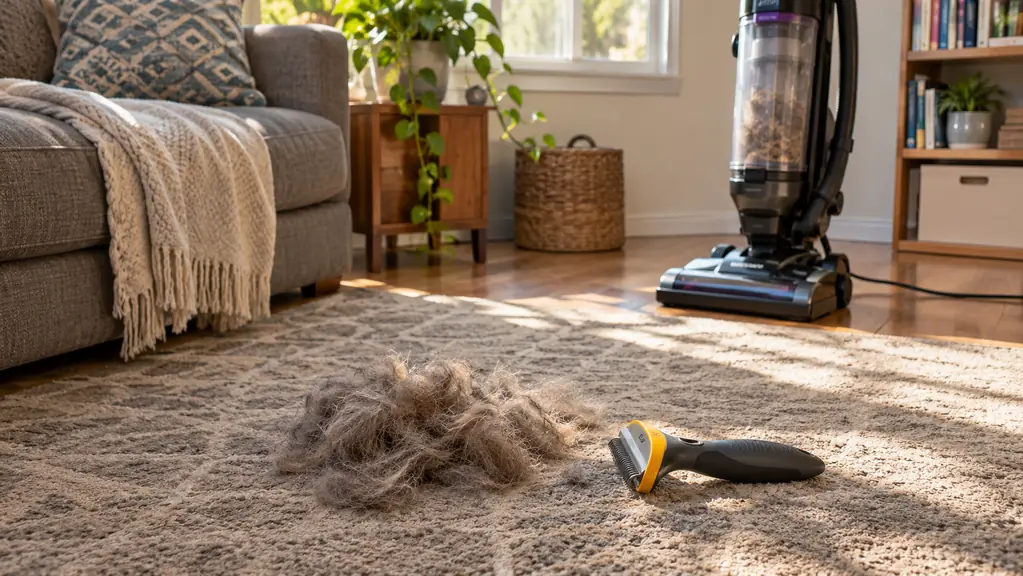
The first change was on the floor. I have a light rug in the living room and I was vacuuming it twice a week, and not lightly. By about the sixth week I was doing it once, and the canister was less full when I did. I want to be careful here, because I have read enough enthusiastic reviews to know how this sounds. I did not buy a tool that stops a Maine Coon from shedding. I bought one that gets the loose hair off him before it lands, which means the rug takes longer to look bad.
The second change was in the coat itself. The ruff sits up now instead of lying in flat clumps, and the hair along his spine has a shine it did not have in January. The britches are the honest measure, though. For years I found mats there in spring and fall, and this year I found one, small, in April, and I caught it with the tool before it tightened.
The third change was him, and I will be careful about this one. Barnaby is eight and has been a little stiff hopping onto the bed. A grooming tool did not fix that and I would not tell you it did. If your cat is stiff, that is a conversation for your vet. What I will say is that he sits longer for the brush now than he did in January, and a cat who is comfortable in his own coat tends to hang around longer. I will take that.
One full session on Barnaby fills the wastebasket with hair that would otherwise be on my rug or in his stomach.
The Parts I Don't Love
This is not a brush you use while thinking about something else. The teeth are made to reach the undercoat, and they will reach skin if you press. Light pressure, short strokes, and stop when the cat tells you to stop. I learned that in the first week and Barnaby learned it in the first week, and neither of us has forgotten.
He will not let me do his belly. I have quit asking. There is no version of that argument I win, and a cat who decides the tool hurts will not sit still for it again. If your cat is the same, do the back, the ruff, the flanks, and the britches, and let the belly alone.
There is one size, and it is sized for medium and large long hair cats over about four and a half kilos with a coat longer than five centimeters. Barnaby is well past both numbers. If your cat is small, or short-haired, or a kitten, this is the wrong tool and the company makes other versions. That is not a flaw exactly. It is a narrow tool that does one job well, and you should buy it knowing that.
What I Liked
- Reaches the undercoat on a large cat instead of skimming the top of the coat
- The FURejector button empties the head in one press over the bin
- Textured, non-slip handle stays put when the cat shifts under your hand
- Ten to twenty minutes, once or twice a week, is genuinely enough when you keep up
- Stainless steel teeth have held up through months of use with no dulling I can feel
Where It Falls Short
- Will not remove a mat that has already formed; those still need scissors or a groomer
- Fine teeth punish a heavy hand, so light pressure is not optional
- One size only, aimed at medium and large long hair cats over about four and a half kilos
- Barnaby will not allow it on his belly and I have stopped asking
- Doing it in five minutes means skipping the ruff and the britches
The Hairball Question
FURminator lists reduced hairballs as one of the benefits, and I want to be straight about what I can and cannot say. Barnaby has brought one up maybe three or four times a year since he was young. In the months since February I have cleaned up one, in June, after a week when I was away and my daughter brushed him twice instead of four times. That is one cat and one season, which is not evidence of much. It is consistent with the plain mechanics, though: hair that comes off on the tool is hair he does not swallow.
If your cat brings up hairballs often, more than once a month or so, that is worth a call to our vet rather than a new brush. Frequent hairballs can mean something else is going on. A deShedding tool is a maintenance habit, not a treatment, and I would rather say that plainly than sell you a brush for a problem that needs a doctor.
What I Tried Before This
A slicker brush was the first thing I bought, years ago, and I still keep one by the door. It is a good tool. On Barnaby it works the top inch of the coat and leaves the undercoat underneath, which is why I could brush him for ten minutes and still find a mat the following week.
A wide-toothed comb is the right thing for the ruff after a bath, when the hair is damp and I want to separate it without pulling. It does nothing for the undercoat on a dry cat, which was the problem I was actually trying to solve.
A rubber grooming mitt was the third attempt. He enjoyed it, which is not nothing, and it picked up surface hair. It did not get under anything. I still use it in July, when he is lying flat in the heat and I want to do something for two minutes without starting a whole session.
None of those were a waste. What the FURminator does that the others did not is reach the layer where the mats begin. I use it first now, for the undercoat, then a slicker over the top to tidy what is left. The two of them together take about fifteen minutes on a Sunday, and Barnaby has stopped leaving the room when he sees either one.
Who This Is For
Owners of medium and large long-haired cats, the kind that weigh more than about four and a half kilos and carry a coat longer than five centimeters. Maine Coons, Norwegian Forest Cats, Ragdolls, Persians, and the big domestic longhairs that turn out to be half Maine Coon once you see them. It suits a cat who will sit still for ten minutes and be handled along the back and flanks, and an owner who wants a routine rather than a rescue. If you brush twice a week and still find mats, this is aimed at you.
Who Should Skip It
Skip it if your cat has a short coat, because the teeth are built for depth and there is no depth to work with. Skip it if your cat panics at being touched along the back, and talk to your vet or a groomer instead of pushing through, because one bad session can end the whole habit. Skip it if the coat is already matted to the skin, since the tool cannot cut a mat out and pulling at one hurts. And skip it if you want something that does the job in two minutes while the cat walks past. Nothing does that. This at least does the job in ten.
If the undercoat is winning, start with the tool built for it
Barnaby is eight, eighteen pounds, and still leaving hair on the rug. Ten to twenty minutes, once or twice a week, has kept the mats away since February. If your cat is in the same size bracket, this is the one I would put in your hand.
Amazon Check Today's Price on Amazon →