
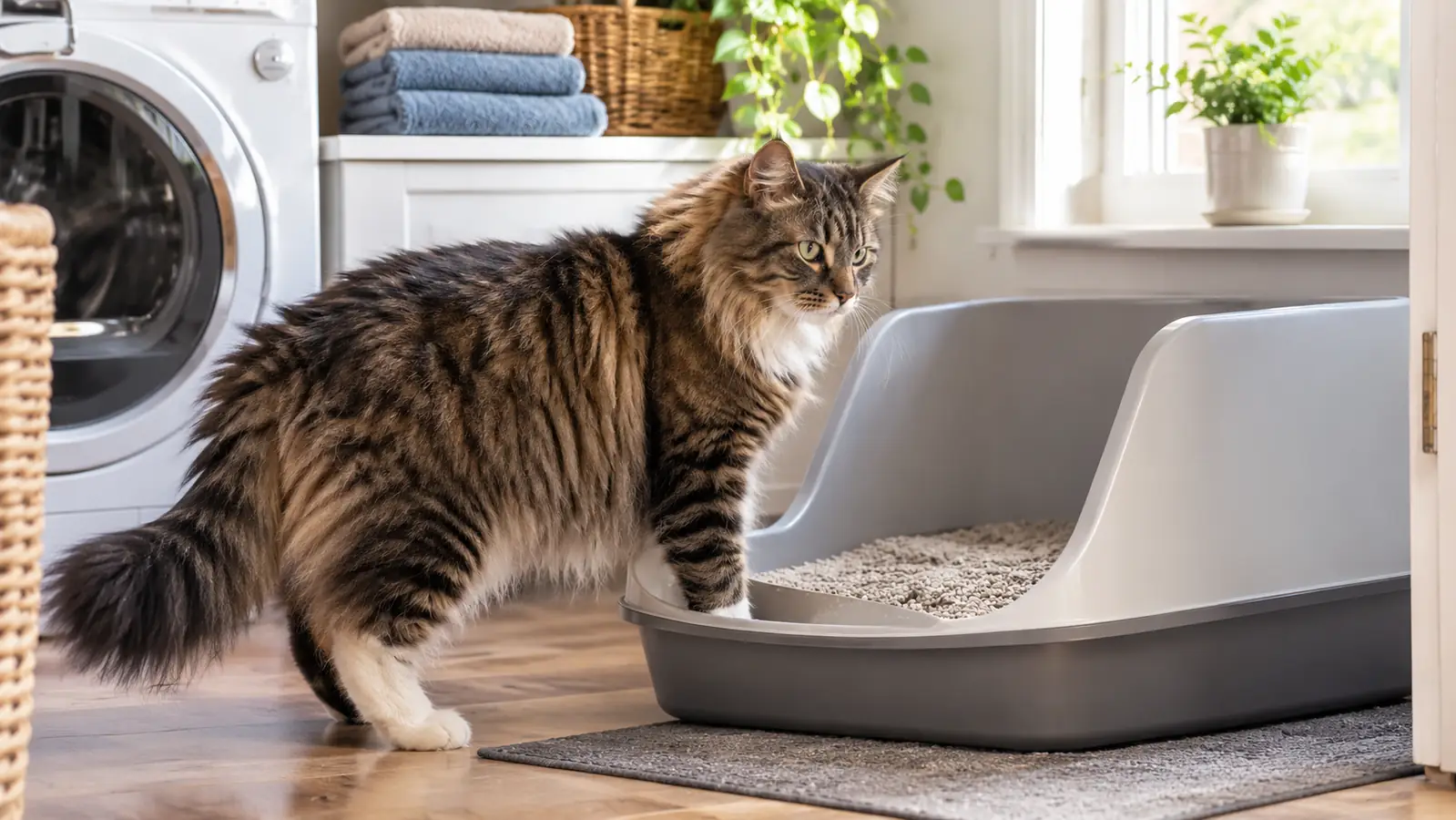
Barnaby is eighteen pounds of long-haired Maine Coon, and for the better part of two years the litter box in this house was a negotiation I kept losing. He would step into the old pan, turn around twice, hang one back paw over the edge, and dig like a dog burying a bone. Litter landed on the floor in a fan three feet wide. I swept twice a day and still crunched in my socks when I walked into the laundry room.
That is how the IRIS USA XX-Large High Sided Cat Litter Box ended up in the corner of my laundry room. It has been there for months now, through the cold snap in January and the muddy stretch in April, used every day by one cat who is bigger than most of the pans sold for him. I am not the sort of person who expected to have opinions about a plastic box, but I have a few, and some of them are not flattering.
The Quick Verdict
Big enough that Barnaby can turn all the way around without perching on the rim, and tall enough that the digging mostly stays inside. The cost is floor space and a plastic pan that needs a real cleaning schedule.
Amazon Check Today's Price →The Pan That Ended My Twice-a-Day Sweeping
Thirty inches long, twenty wide, fourteen tall, and sized for cats who outgrew the standard pan. Check today's price and the current size options on Amazon.
Amazon Check Today's Price on Amazon →How I've Used It
It lives in the corner of my laundry room, next to the dryer, because that is the one wall in this house with enough clearance and a floor I do not mind scrubbing. I put an old rubber mat underneath it the first week, mostly because I did not trust the walls to do their job. The mat is still there. The floor under it has stayed dry, which is more than I can say for the spot where the old pan sat.
My routine has not changed much. I scoop in the morning after I feed Barnaby and again before I go to bed, and I keep the litter a few inches deep because he likes to dig down and needs something to dig in. He walks in, turns around once, does his business, and covers it. That sounds like nothing. If you have ever watched a large cat try to bury something in a pan that is too small for him, you know it is not nothing.
What I tried first was cheaper and worse. I bought a clear plastic storage bin from the hardware store, cut a notch in one side with a utility knife, and set it where the old pan had been. Barnaby used it. He also dragged litter over the top edge every single time because the plastic was thin and flexed under his weight, and after six weeks the cut edge had cracked. Then I tried a covered box a neighbor gave me, and he would not go in it. He stood outside it and yowled until I took the lid off. That was the point where I stopped improvising and looked for something actually made for a cat his size. The IRIS box was the answer I landed on.
I have been running this box since the middle of winter. Barnaby is eight and has gotten a little stiff in the back end, so I watch how he gets in and out more than I used to. I also have a grown daughter and three grandchildren who come by on Sundays, and the laundry room is where the coats go, so a box that gets used right before a visit is a real thing I think about.
What 30 by 20 Inches Actually Changes
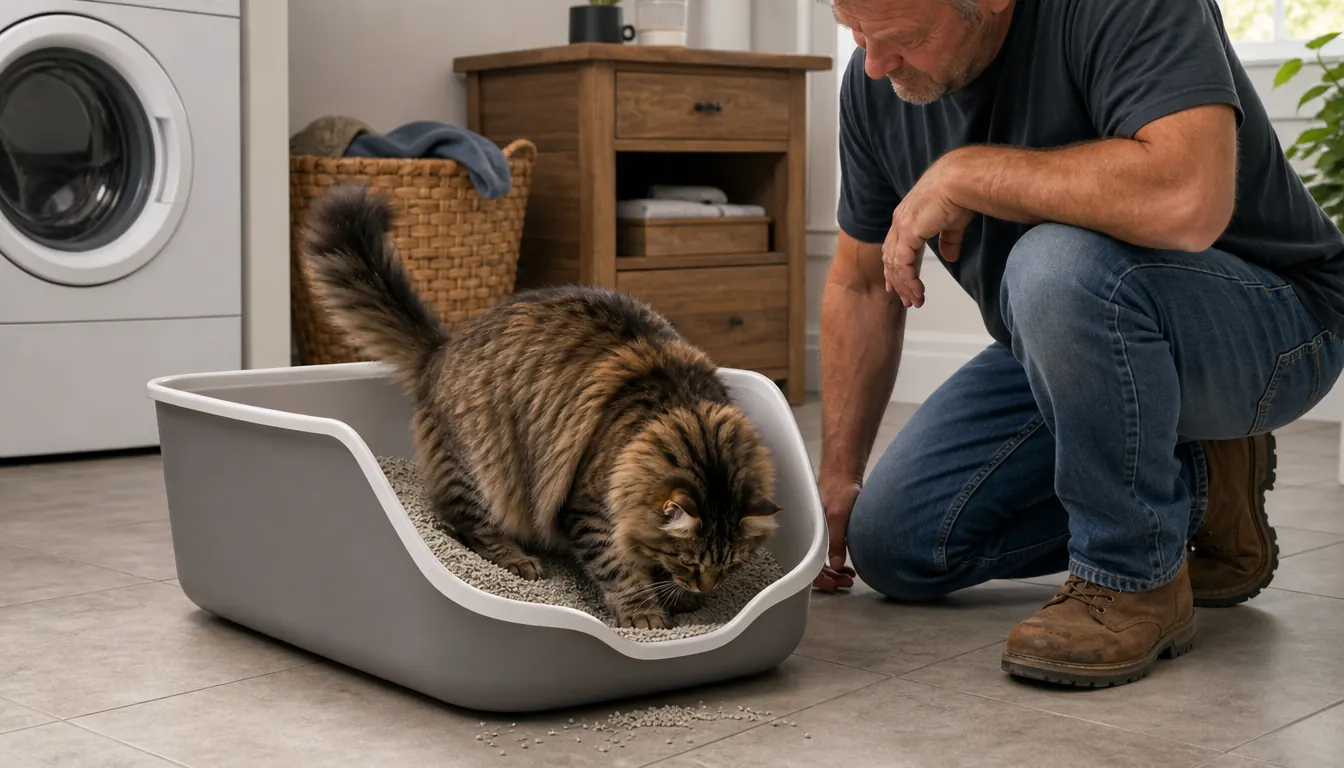
The box measures 30 inches long, 20 inches wide, and 14 inches tall. The pan it replaced was about 22 inches long, which I had convinced myself was fine. It was not fine. Barnaby is roughly 18 pounds with a long body, and in the old pan he had to choose between standing halfway out or turning with his rear end against a wall.
In this one he can walk in, turn a full circle, dig, and cover without a paw going over the edge. That single change fixed most of my complaints. The digging stays inside. The covering stays inside. He does not kick over the rim because he is not fighting the rim anymore.
I measured before I ordered, which is not something I always do. The gap between the dryer and the wall in my laundry room is 26 inches, and the box is 30, so it does not go there. It sits along the long wall under the window instead, with about four inches of clearance on the right side so I can get my hand in with the scoop. The old pan was 22 inches long and 16 wide, which left a lot of empty floor around it and made the room feel bigger than it was. The new one takes up that space and then some. I moved a hamper to the hall closet to make it fit, and I have not missed the hamper.
The trade is floor space, and it is not a small trade. Thirty by twenty inches is a genuine footprint, and in a small house you will notice it. It did not fit between the dryer and the wall the way I had pictured. If your only options are a narrow closet or a bathroom squeezed between a vanity and a door, measure first and be honest about the answer.
The 14-Inch Walls and the 6.5-Inch Entrance
The walls are 14 inches tall, and the entrance is a curved opening about 6.5 inches high rather than a flat cut-down side. The practical effect is that Barnaby can get in and out easily while the litter he throws around mostly hits a wall instead of my floor.
It also gives him some privacy, which he seems to want. He is a cat who does not like being watched while he is in the box, and a cat who does not like being watched will find creative places to go instead. Since the switch there has been no creative place. That matters more to me than the sweeping did.
The first week I watched him more than I would have admitted out loud. He came into the laundry room, put his front paws on the entrance, looked over the wall, and then stepped up with his back end in a way that looked like work. By the fourth day he was doing it in one motion, the way he does everything, without any fuss. What I noticed was the digging. In the old pan he dug in short, frustrated scrapes because his rear end was against a wall. Here he digs in long strokes from the front corner to the back, and then he turns around and covers it properly. It is a small thing, watching a cat be able to do the normal thing. It also told me the height was right for him and would not be right for every cat.
What the tall walls cost you is access. You are reaching over 14 inches to scoop, and if you are short like me, or if your back is not what it was, you will feel it. I keep a small step stool by the dryer now, which I did not expect to need. And the entrance, low as it is, is still a step up. Barnaby manages it without thinking, but he is a big cat with long legs. If your cat has real trouble with stairs or has been diagnosed with arthritis, ask your vet before you buy a high sided box, because a cat in pain will start going on the rug and no litter box is worth that.
Cleaning, Tracking, and Odor After Several Months
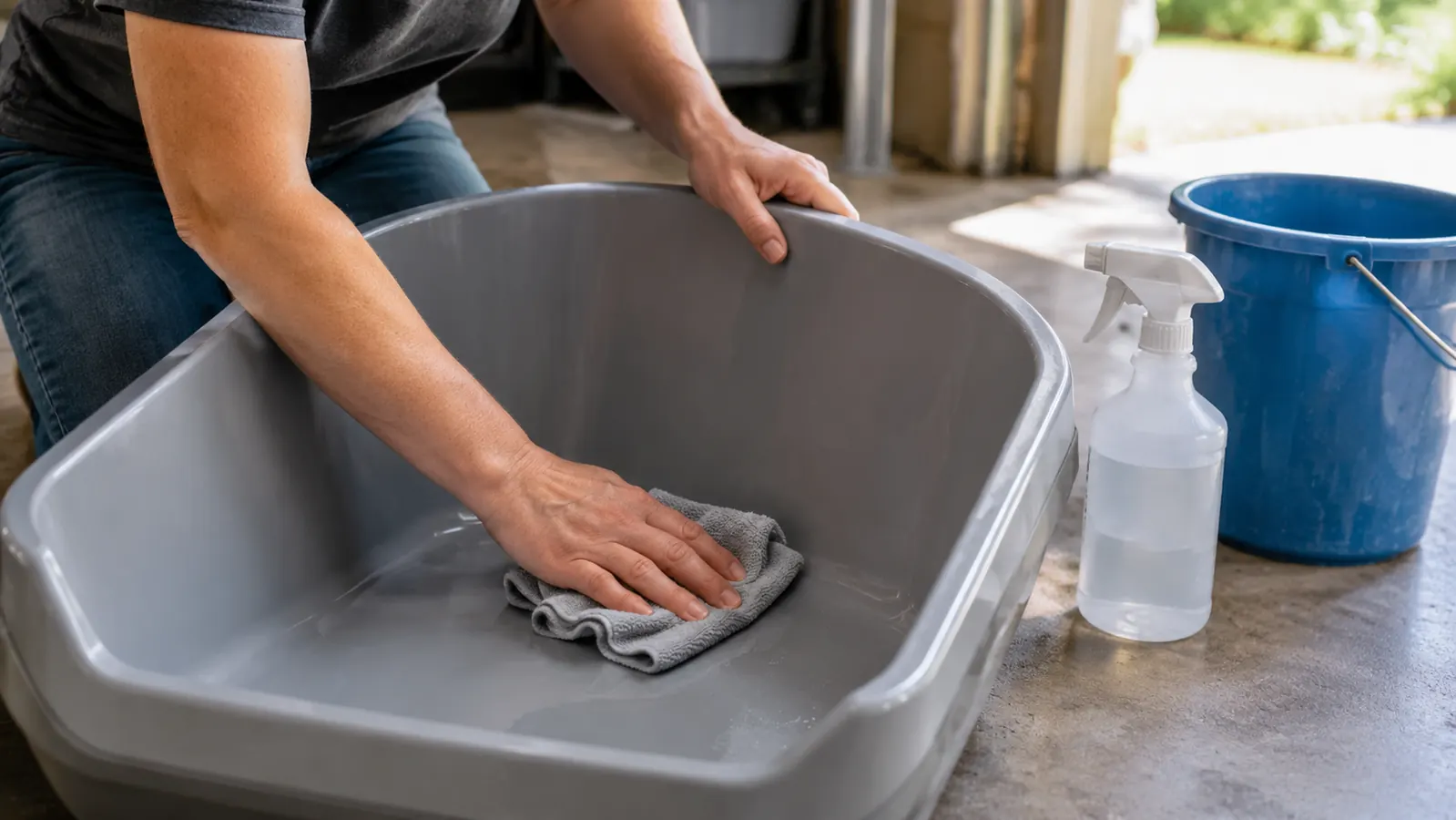
The inside is smooth with rounded corners and very few seams, and that is the part of this box I have come to appreciate most. Wiping it down takes a couple of minutes. There is no textured floor to scrub litter out of, no channel where urine can sit, and nothing to take apart and put back together. I empty it completely once a week, wash it with a mild soap and hot water, dry it on the porch when the weather allows, and refill.
April is the test I did not plan for. Barnaby goes out on the screened porch and comes back with damp paws, and damp paws carry litter out of the box in a way dry paws do not. For about three weeks I was sweeping again, and I will be honest that I blamed the box before I blamed the weather. What fixed it was a coarser mat right at the entrance and a second mat at the laundry room door, plus a switch to pellet litter for the wet weeks. The IRIS USA box was not the problem. It has not been the problem since. That is worth saying plainly, because I went into this expecting to be disappointed.
Tracking is reduced but not gone. The scatter shield handles the litter a cat kicks backward. It does nothing about the litter that sticks to long fur between the toes and gets carried out onto the floor. With a Maine Coon, that is most of my tracking, and no box on the market fixes it. What helped was a coarse mat in front of the box and a weekly brushing that takes the loose litter out with the loose fur.
Plastic is plastic. After several months of daily use the box is intact, no cracks, no warping, and the walls have not bowed. But plastic does hold odor over time in a way that a metal pan does not, and this one carries no warranty at all. My plan is to replace it when scrubbing no longer does the job, probably somewhere around the two year mark, and to treat that as the ordinary cost of owning a plastic box rather than something to be disappointed about. If you want a pan you never have to think about replacing, a stainless steel one is the honest answer, and I compared the two at length before I bought this one.
Where It Falls Short
The footprint is the big one. This is a large object and it will not hide. There is no lid and no enclosed compartment, so if you were hoping to tuck the box into a living room corner and forget it, this is not that product. It is an open pan with tall walls, and it looks like exactly what it is.
The other thing I would flag is the look of it. A 30 inch open pan in a laundry room is a 30 inch open pan. It does not pretend to be furniture, and there is no version of this box that hides. If the box lives somewhere guests will see, an enclosed box or a cabinet will suit you better, even though you give up some of the room inside.
Two smaller things. The listing includes the litter container and nothing else, so there is no scoop in the box, which I found out the ordinary way. And there is no warranty on it. I knew both of those before I bought and I still bought, but you should know them too. The high walls also make it a poor fit for a kitten, a very small cat, or an older cat with mobility problems, not because the box is badly made but because getting in and out is a real climb.
What I Liked
- 30 by 20 inches of floor space inside the pan, enough for an 18 pound cat to turn around fully
- 14 inch walls and a 6.5 inch curved entrance keep digging and spray inside without walling the cat out
- Smooth interior with minimal crevices makes a full wipe down a two minute job
- Held its shape through months of daily use with no cracks, no warping, and no bowing walls
Where It Falls Short
- Large footprint that will not fit a narrow closet or a tight bathroom corner
- No lid and no enclosure, so it stays fully visible wherever you put it
- No warranty on the box and no scoop included
- Plastic will hold odor eventually, so plan on replacing it
- The step over the entrance is hard on a cat with joint trouble
Thirty inches long and fourteen inches tall is the difference between a cat who fits and a cat who perches. Barnaby stopped perching in the first week.
Who This Is For
This box is for someone with a genuinely large cat. A Maine Coon, a Ragdoll, a Savannah, or a big domestic longhair who has been hanging over the edge of a standard pan for years. It is also for anyone tired of sweeping. The scatter shield and the tall walls do real work, and if you have a cat who digs with enthusiasm you will notice the difference inside the first week.
It suits a house with one dedicated spot, a laundry room, a mudroom, a spare bathroom, where the box can sit against a wall and be left alone. If you have that spot, this box will do its job quietly for a long time. The IRIS USA box has.
Who Should Skip It
Skip it if your cat is small. A seven pound cat in a 30 inch pan is a cat swimming in a bathtub, and some cats will not use a box that feels that open. Skip it if you have no floor space to give, because this box does not compromise on that and neither should you.
Skip it if your cat is old, arthritic, or recovering from surgery. Getting over a 6.5 inch entrance and down again is harder than it looks from standing height. For a stiff cat, a low entry pan or a plain under bed storage bin with one side cut down is the kinder choice. That is a conversation to have with your vet, not with me.
If Your Cat Has Outgrown the Pan, This Is the One I Would Buy Again
Thirty inches long, twenty wide, fourteen tall, and it has survived a Maine winter in my laundry room. Check today's price on Amazon.
Amazon Check Today's Price on Amazon →