There are two kinds of cat grooming reviews. The first is written by someone who brushed their cat once for a photograph and formed a lifelong opinion. The second is written by someone who has done it twice a week for five years and has a shelf of tools that did not earn their place. I am in the second group. My FURminator undercoat tool for medium and large long-haired cats lives by the back door, and I have run it over Barnaby, my eight-year-old Maine Coon, since he was about three. That is long enough to tell you what it does, what it does not do, and which of the package claims deserve a raised eyebrow.
The short version, for anyone who does not want a couple thousand words from a retired librarian: it pulls out an alarming amount of loose undercoat, it will not detangle a single mat, and it is not a substitute for knowing how to hold a comb. On a clean, dry, mat-free coat, twice a week, it noticeably cuts down the fur in the dryer filter and the hairballs on the rug. On a tangled coat it sits in the drawer until the tangles are gone. That is the honest shape of it.
The Quick Verdict
Very good at lifting loose undercoat off a large long-haired cat. Not a detangler, and not gentle if you press.
Amazon Check Today's Price →The one tool on my shelf that earns its hook by the back door
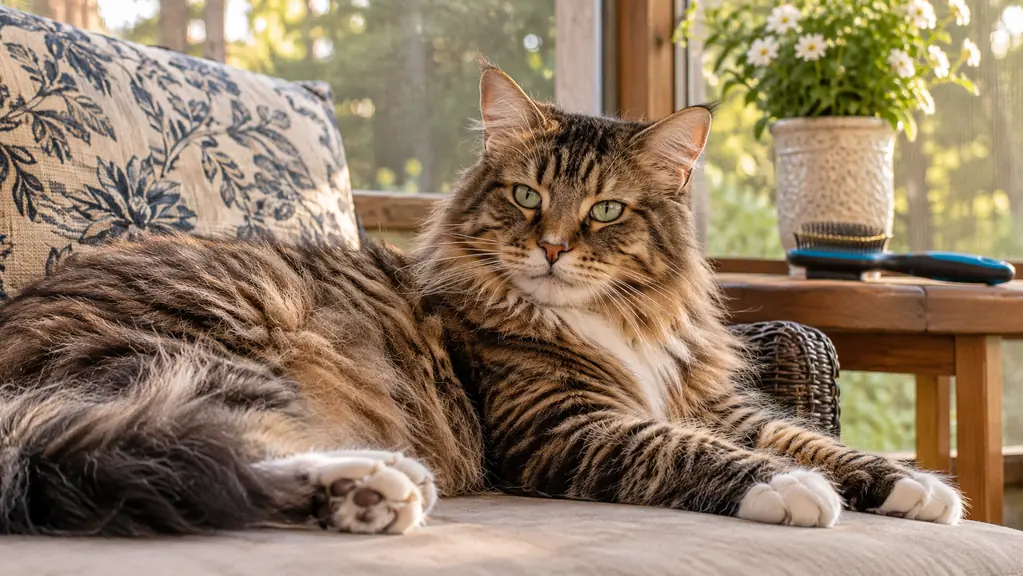
Barnaby is eighteen pounds of coat. This is what I reach for between Sunday breakfast and the laundry, twice a week, on dry fur.
Amazon Check Today's Price on Amazon →What Nobody Tells You Before You Buy One
The first thing to understand is that the FURminator is not a brush. It is a stainless steel blade set in a handle, and the teeth sit close together so they catch loose undercoat instead of riding over the top of it. That is why it works, and also why it asks for a little care. A brush you can drag anywhere. A blade edge you use with some attention, in short strokes, following the way the coat grows, with a light hand.
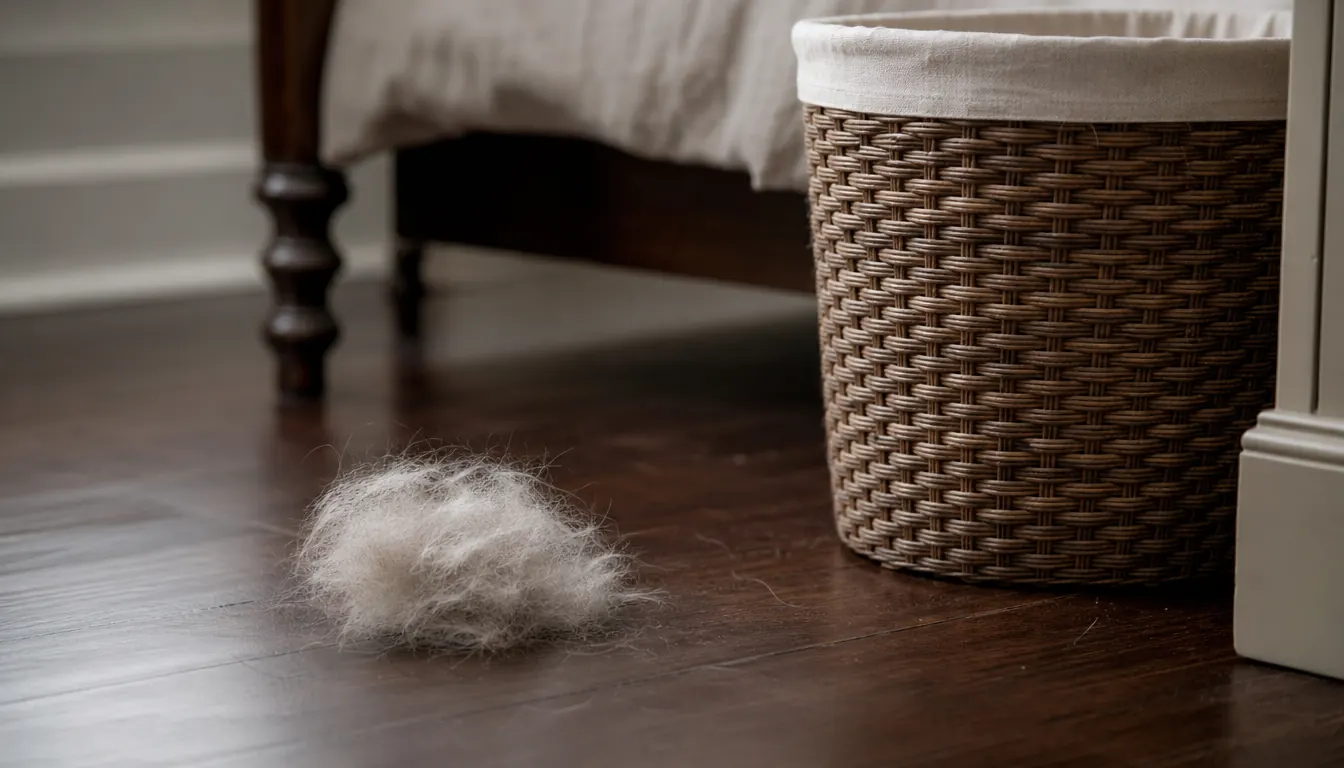
The package number is ninety percent of loose hair removed, and I have no way to measure that and neither do you. What I can tell you is that the first session on Barnaby each April produces a pile roughly the size of a second cat, and that the pile has been that size every spring since. Whether the true figure is ninety or seventy, the dryer filter knows the difference.
The second thing is sizing. This model is built for medium and large cats over roughly ten pounds with a coat longer than a couple of inches, and Barnaby at eighteen pounds with his shaggy ruff is exactly the customer they had in mind. If you have a small short-haired cat, this is the wrong tool and it will feel clumsy in your hand. Buy the one that matches the cat.
The third thing, and the one I wish were printed larger, is the instruction to use it on dry hair only, once or twice a week, for ten to twenty minutes a session. That reads like a suggestion. It is closer to the operating instructions. Damp fur clumps and the teeth grab. And more than twice a week in the same spot stops being grooming and starts being scraping, because once the loose undercoat is gone the tool will keep taking whatever is under it.
Where it fits against a comb, since that is the question I get most. A metal comb finds mats and works them apart. A slicker brush fluffs the top coat. This removes the dead undercoat the other two leave behind, and that undercoat is what ends up on your sofa and in your laundry. You do not need all three, but you do need the comb if your cat mats and you need this if your cat sheds. They are different jobs and I wish someone had said so to me plainly at the start.
How I Actually Use It on Barnaby
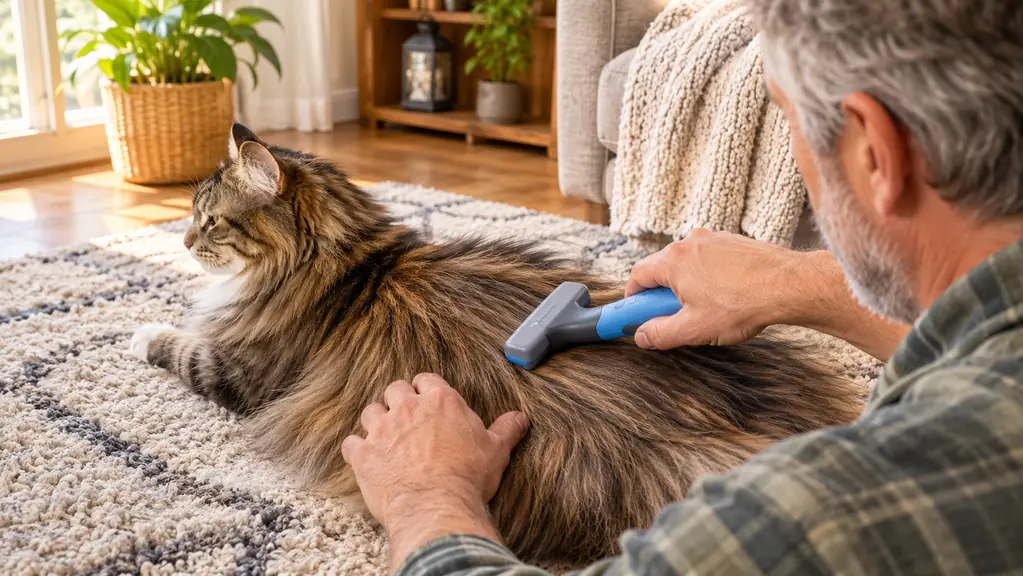
Sunday morning after breakfast and Wednesday evening before the news. That is the whole schedule, and it runs about fifteen minutes each time, inside the ten to twenty minute window on the package. I start at his shoulders because that is where he is most willing, work back along his sides in short strokes, then do the ruff and the back of the neck. He lies down somewhere around the third stroke and complains mildly if I stop.
Getting a cat used to it takes a week or two and a certain amount of patience I did not always have. The first few sessions I did thirty seconds and quit while he was still content, then a minute, then five. If your cat is already a lap cat you can skip that. If your cat leaves the room when a brush comes out, do the short-session version. The tool is not going to win an argument and you do not want it to try.
Knowing when to stop is its own small skill, and the tool will tell you. When the strokes come up nearly empty, the loose undercoat is gone and anything further is just scraping a cat for no reason. In April that takes a while. In January I am finished in eight or nine minutes and I put it away.
The FURejector button is the part I did not expect to care about and now use a dozen times a session. You press it and the mat of collected fur slides off the teeth instead of sitting there until you pick it out with your fingers. Small thing. It is the difference between a tool I use and a tool I avoid because it is fiddly. I keep a wastebasket by my chair and press it over that, because fur dropped on the rug becomes the most interesting object in the house.
The handle is the other quiet virtue. It is padded, it does not slip even when my hands are dry from December, and the whole tool weighs under six ounces, so fifteen minutes of it does not tire my wrist. It is small enough to sit in a drawer, about two by five by nine inches, which matters in a house with one cupboard for cat things.
Fifteen minutes, twice a week. The fur in my dryer filter roughly halved and the hairballs went from weekly to something closer to monthly. What it never touched was the matting behind his back legs.
The Part That Surprised Me
What I did not expect was the hairballs. The package says the tool helps reduce them by taking loose hair off the cat before he swallows it, and that reads like marketing until you have lived with the same long-haired cat for a year and then added a brushing routine. I am not going to tell you it prevents them. I will tell you what I counted. It went from roughly weekly to something closer to monthly, and the ones he does bring up are smaller.
His coat looks better too, and I want to be careful how I say that. It is not shinier or softer because of anything in the tool, which is a blade and nothing else. It looks better because dead undercoat is no longer sitting in it, matting the top layer down and making him look heavier than he is. A brushed-out Maine Coon looks like the cat he actually is.
The other surprise was that Barnaby tolerates it, which I had not counted on. He is a gentle, chatty cat who follows me room to room, but he does not care to be handled at length. A slicker brush he will accept for about four minutes and then he walks. This he will take for fifteen. My guess is that the teeth reach the undercoat and scratch the itch he cannot get to himself, but that is a guess and not a claim I can prove.
Where It Falls Short
Behind the back legs. Barnaby grows what amounts to trousers back there, thick and soft and prone to matting if I skip a week, and this tool is not the answer. The teeth catch the top of a mat and pull, which is uncomfortable for him and useless for me. Those spots get a metal comb first, worked in from the outer edge, and the deShedding tool comes out afterward on the loosened hair. If your cat already has mats, deal with them before you buy this, or buy a comb at the same time.
The belly is a second no. Not because the tool fails but because Barnaby has opinions about anyone near his stomach, and a blade edge is not something I want to argue with a cat about near thin skin. The tail plume is a third. It looks like the perfect target and it is mostly guard hair up top, so the tool does very little there except annoy him.
And the honest limit is pressure. It is easy to press and pressing is wrong. Light strokes that follow the coat, letting the teeth do the work, is the whole technique. Lean into it and you will scrape skin, and a cat that gets scraped once remembers it for a month. I learned that in his third year and I have not repeated it.
One more expectation to set. In a heavy shed this is a fifteen minute job twice a week and it will still look like you are losing. Maine Coons blow coat in spring in a way that feels personal. The tool cuts the volume. It does not stop the process, and nothing does. It ends when it ends, and by June you have your cat back.
What I Liked
- Lifts loose undercoat off a large long-haired cat faster than any brush I own
- The FURejector button clears collected fur with one press instead of picking it out by hand
- Padded non-slip handle and under six ounces, so fifteen minutes does not tire my wrist
- Barnaby tolerates a full session, which is more than I can say for the slicker brush
- Small enough to live in a drawer between sessions
Where It Falls Short
- Does nothing useful on mats, and pulls on them
- Easy to overuse; more than twice a week in one spot is too much
- Wrong tool for small or short-haired cats
- The belly and the tail plume are out of reach in practice
- You still need a metal comb for the britches
Who This Is For
If you have a medium or large cat with a long coat, over about ten pounds, and you are willing to brush twice a week on dry fur with a light hand, this is the tool I would hand you. It suits the cat who produces drifts of undercoat in spring and again in fall, and the owner who is tired of finding fur in the dryer filter and on the good chair.
It is also for the person who has been using a human hairbrush, which does close to nothing on a Maine Coon. I say that without judgment because I did it for a year. A brush moves fur around. This lifts it out.
And for the friend whose cat hates being brushed: start with the comb at the spots the cat will allow, then add the deShedding tool on the easy half of the back, and stop there. Grooming a cat is a negotiation and the tool is only half of it. Some cats come around in a month and some never do, and a cat who never does is not a failure on your part.
Who Should Skip It
Skip it if your cat has mats right now, if your cat is small or short-haired, or if your cat will not be handled at all. A cat who will not tolerate fifteen minutes of brushing is a cat who needs your vet or a groomer rather than a sharper tool at home. And skip it if you want one thing that does everything. This does one job, it does that job well, and it does not do the others.
One more caution and then I will stop fussing. Any change in coat, skin, or tolerance for being touched is a vet question, not a tool question. If your cat is over-grooming, or losing fur in patches, or suddenly hates being handled, put the tool down and make the call.
The Plain Answer
It costs more than a drugstore brush and I think it is the better use of the money. A stainless steel edge that has held up for five years does a job the cheap brush cannot do at all, and a cheap tool that does nothing is the expensive one in the end. That is the same arithmetic I use on kitchen knives and it has not let me down yet.
I have had this tool for five years, I use it twice a week, and I would buy it again tomorrow. The FURminator is not a cure for anything and it is not a replacement for a comb, a vet, or ten minutes of your attention. What it is: a well-made stainless steel undercoat blade sized for a big long-haired cat, with a button that clears the fur and a handle that does not slip. For Barnaby that has meant less fur in the laundry, fewer hairballs on the rug, and a cat who lies down when he hears it come off the hook.
Five years in, it is still the first thing I reach for
If your cat's coat is long and already free of mats, this is where I would start. Twice a week, dry fur, ten to twenty minutes, light hand.
Amazon Check Today's Price on Amazon →