
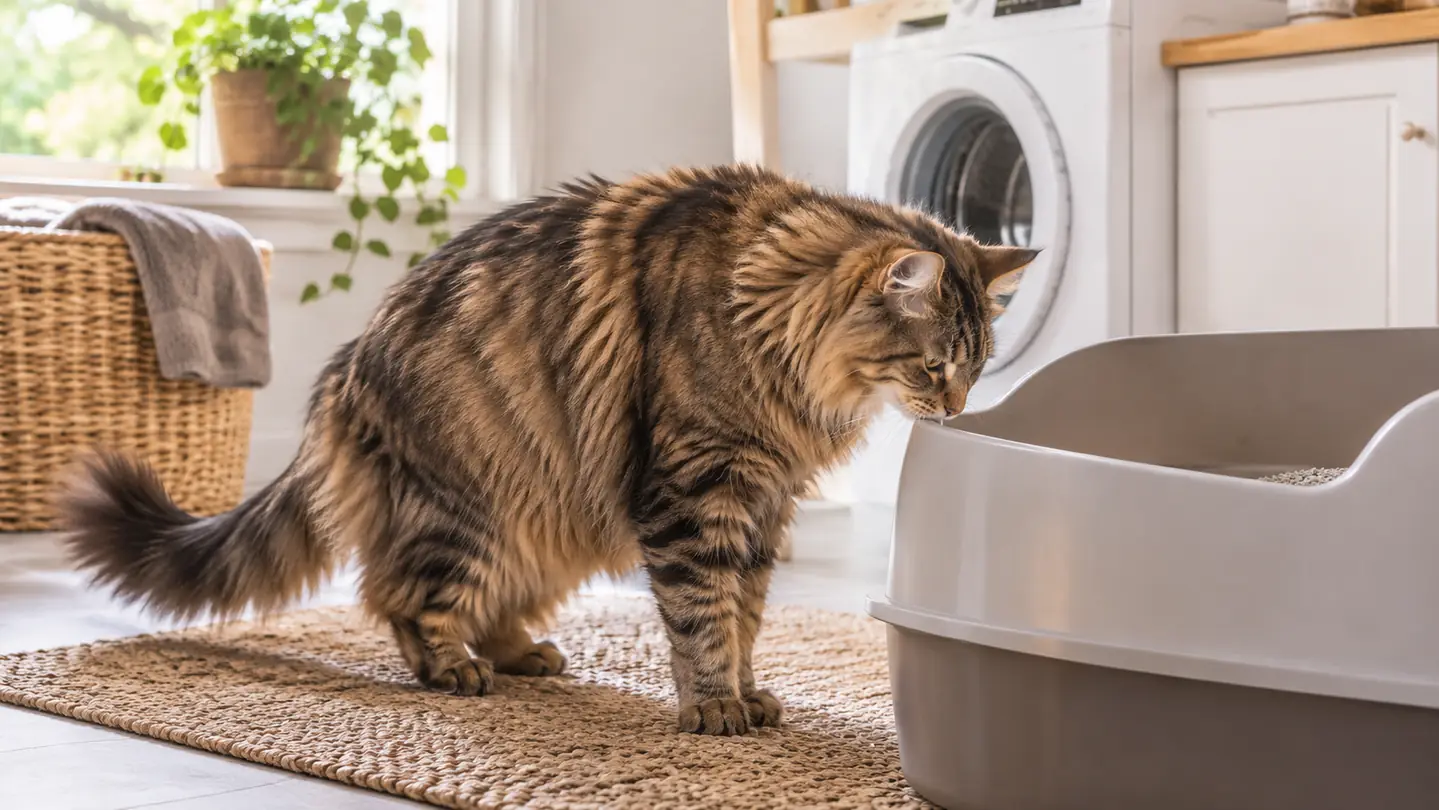
I did not buy the IRIS USA XX-Large High Sided Cat Litter Box because it looked nice. I bought it because Barnaby, my 8-year-old brown tabby Maine Coon, had started treating his old box like a suggestion. He is about 18 pounds with a long shaggy coat, a thick ruff, and britches that mat behind his back legs if I skip a week of brushing. The old pan was fine when he was younger and smaller. By this winter he was standing with his front paws on the rim, and I was finding urine on the laundry room floor more mornings than I want to admit. A friend asked why I did not just get a covered box. I had one years ago. Barnaby hated it, and I hated cleaning the inside of it. So I ordered the IRIS USA pan instead. This is the review I wish I had read first, including the parts that are not convenient.
The short version: this box solved the problem I bought it to solve. The 30-inch length and 20-inch width give Barnaby room to turn around without his back end hanging over the side. The 14-inch walls catch what used to land on the floor. The 6.5-inch curved entrance is low enough that he steps in without a jump. But a box this size is not a free upgrade. It takes up more floor space, it needs more litter, and it is still a plastic pan with no warranty. If you have a large cat and a small bathroom, read the measurements twice. If you have a large cat and a laundry room with a few spare inches, this may be the last box you buy for a while.
The Quick Verdict
A genuinely large pan that fixed my floor problem. It is not a small-room box, and the plastic will show its age.
Amazon Check Today's Price →The first box Barnaby stopped hanging over
The 30 by 20 inch pan and 14 inch walls did what my old mat could not. Check the measurements against your floor space before you order.
Amazon Check Today's Price on Amazon →How I've Used It
I set the IRIS USA box in the same laundry room spot as the old one, on a washable mat, and filled it about three inches deep with the clumping litter Barnaby has always used. I did not change his litter, his food, or his routine. The only difference was the size of the pan. He watched me from the doorway while I worked, then walked over, sniffed the 6.5-inch curved entrance, and stepped in. That was it. No drama. I have had cats who needed a week to accept a new box. Barnaby is not one of them, but I still kept the old box beside it for two days in case he changed his mind. He never used the old one again.
The first thing I noticed was how much less litter ended up on the floor. The 14-inch walls are the reason. When Barnaby digs, the litter hits the wall and falls back in instead of launching over the edge. The listing calls the tall side a scatter shield, and that is a fair name. I still keep a mat under the box because his paws carry a little out when he leaves, but I am no longer sweeping the whole room every morning. The second thing I noticed was the smell. It is an open-top pan, so there is nothing holding odor in. I scoop twice a day and wash the pan once a week. If I skip a day, I know it.
I measured before I ordered, and I am glad I did. The box is 30 inches long, 20 inches wide, and 14 inches tall. It weighs 4.3 pounds empty, so I can lift it with one hand when I take it to the tub to scrub. It is plastic, and the listing says it has no warranty. I mention that because a plastic pan can crack if it is dropped or if a heavy cat lands on one corner. Mine has held up so far. I have not dropped it, and Barnaby is not a leaper. If you have a cat who launches himself into the box from a height, pay attention to that.
What Nobody Tells You About a 30-Inch Litter Box
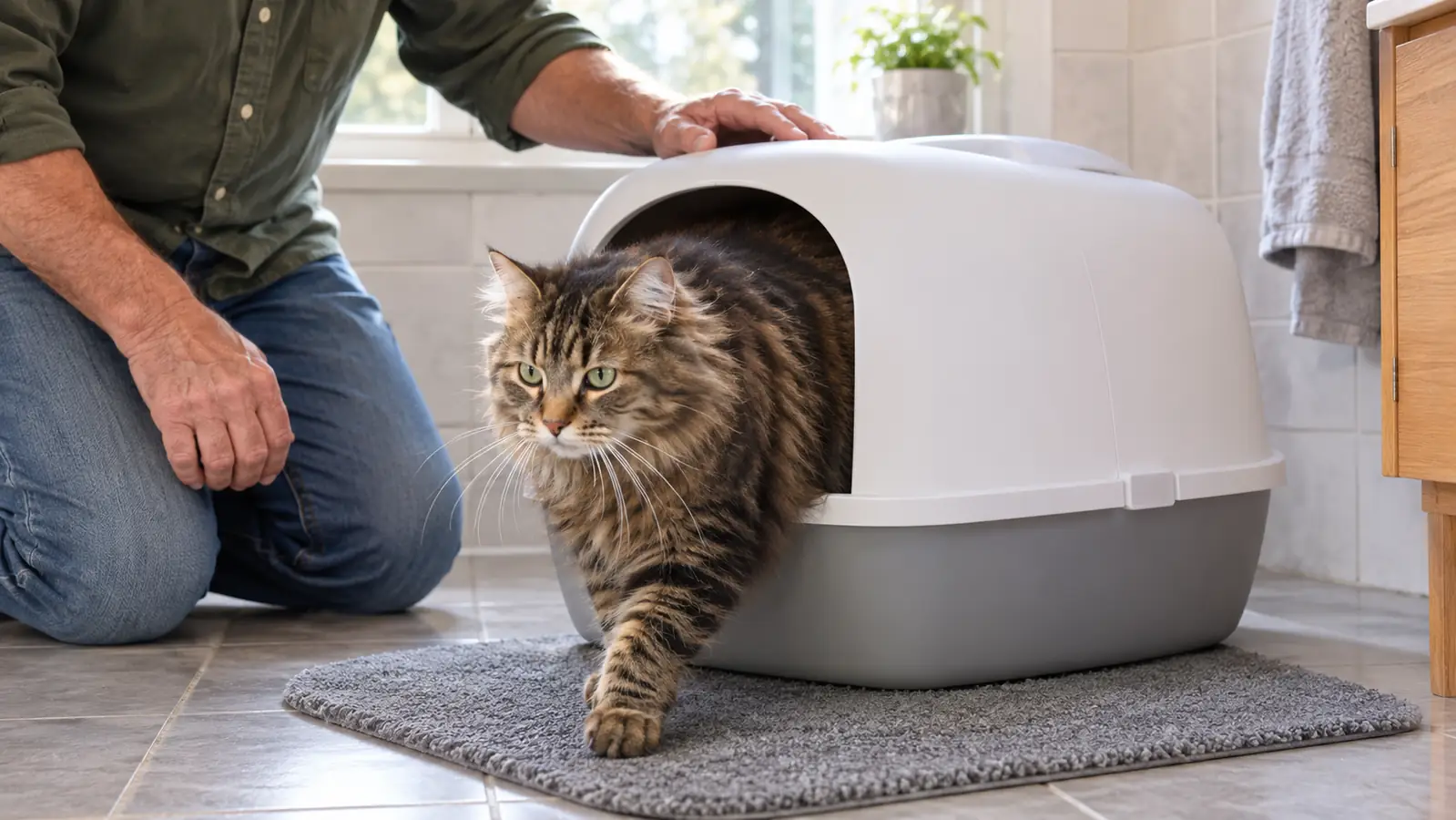
A 30-inch litter box is not just a bigger version of a small one. It changes where the box can go. In my laundry room it fits beside the washer with about two inches to spare. In a small bathroom it would block the door. I have seen people buy an XX-large pan for a big cat and then return it because it did not fit the spot they had in mind. That is not the box's fault, but it is the first thing nobody tells you. Measure the floor space, then measure the path to the laundry room, then measure the doorways. A 30-inch box is not hard to carry, but it is awkward if you have to turn corners.
The second thing is litter. A deeper box with more floor area takes more litter to fill to a useful depth. I fill Barnaby's box about three inches deep, and I use more litter per change than I did with the old pan. That is not a flaw. It is math. If you are trying to keep litter costs down, a giant box will not help. If you are trying to keep urine off the floor, it will. I would rather buy a little more litter than mop the laundry room twice a week. That is the trade I made.
The third thing is cleaning. The listing says the interior is smooth with minimal crevices, and that is true. It wipes down faster than my old box, which had ridges and a rim that collected dust. I use a mild soap and warm water, rinse it well, and let it dry in the sun on the porch when the weather allows. The corners still need a scrub, and the plastic will scratch over time. That is true of every plastic pan I have owned. If you want a box that never scratches, you are looking for stainless steel, not plastic. I have not tried the stainless steel route myself, but I know why people do.
The First Two Weeks: What Actually Changed
The first week was mostly about floor space. I moved the trash can, moved the mat, and moved a stack of laundry baskets that had been living in the corner. The box itself did not move. Barnaby used it on the first day, and he used it every day after. I kept waiting for him to protest because the entrance is a step up rather than a low lip. He did not. The 6.5-inch entrance is low enough that he can step through without jumping, and high enough that the litter stays inside when he digs. For a cat his size, that is the right balance.
The second week was about what I stopped doing. I stopped wiping the floor every morning. I stopped finding clumps stuck to the baseboard. I stopped washing the mat every other day. I did not stop scooping. A big open box does not clean itself, and the odor is more noticeable than it was with a covered box because there is no lid. I scoop in the morning and again before bed. That is the routine. If you are not willing to scoop twice a day, a large open pan will not solve your odor problem. It may make it more obvious.
Barnaby is 8, and he has started to be a little stiff when he jumps onto the bed. Our vet is keeping an eye on that. I was worried the taller side would make the box harder for him. It has not. He steps in through the curved entrance and steps out the same way. The 14-inch wall runs around the box, and the entrance is cut lower at 6.5 inches. If your cat has trouble with stairs, a high jump, or a raised lip, watch how they use it for the first week. If they hesitate, do not force it. Ask your vet about mobility and keep a lower box available if needed.
What I Liked
- Fits a large cat without the back end hanging over
- 14-inch walls keep litter and urine inside
- 6.5-inch curved entrance is easy to step through
- Smooth interior wipes down quickly
- 4.3 pounds empty, so it is easy to lift
- Simple plastic pan with no parts to lose
Where It Falls Short
- Takes up 30 by 20 inches of floor space
- Needs more litter per change
- Open top does not contain odor
- No warranty
- Plastic will scratch over time
The Parts I Don't Love
The size is the main tradeoff, and I do not want to pretend otherwise. This box takes up a serious amount of floor space. In my laundry room it works. In a hall closet or a small guest bathroom it would not. The 30 by 20 inch footprint is the same as a small appliance, and you have to be willing to give that up. I also do not love how much litter it takes to fill. A deeper bed of litter is better for a cat who digs, but it empties a bag faster. If you are on a tight budget, factor that in.
The open top is the other thing. I chose an open pan on purpose because Barnaby hates covered boxes and I hate cleaning the inside of a hood. But an open pan does not hide anything. When he goes, I know it. When I forget to scoop, I know it. The listing lists breathable as a feature. I cannot tell you what that means in a plastic pan. What I notice is that air moves over the litter because there is no lid. That is fine in a laundry room with a door. It would be less fine in a living room. The no-warranty note is also worth repeating. If the pan cracks, you are buying another one.
The 14-inch walls did more for my floor than every mat I bought before them.
Living With It After Six Months
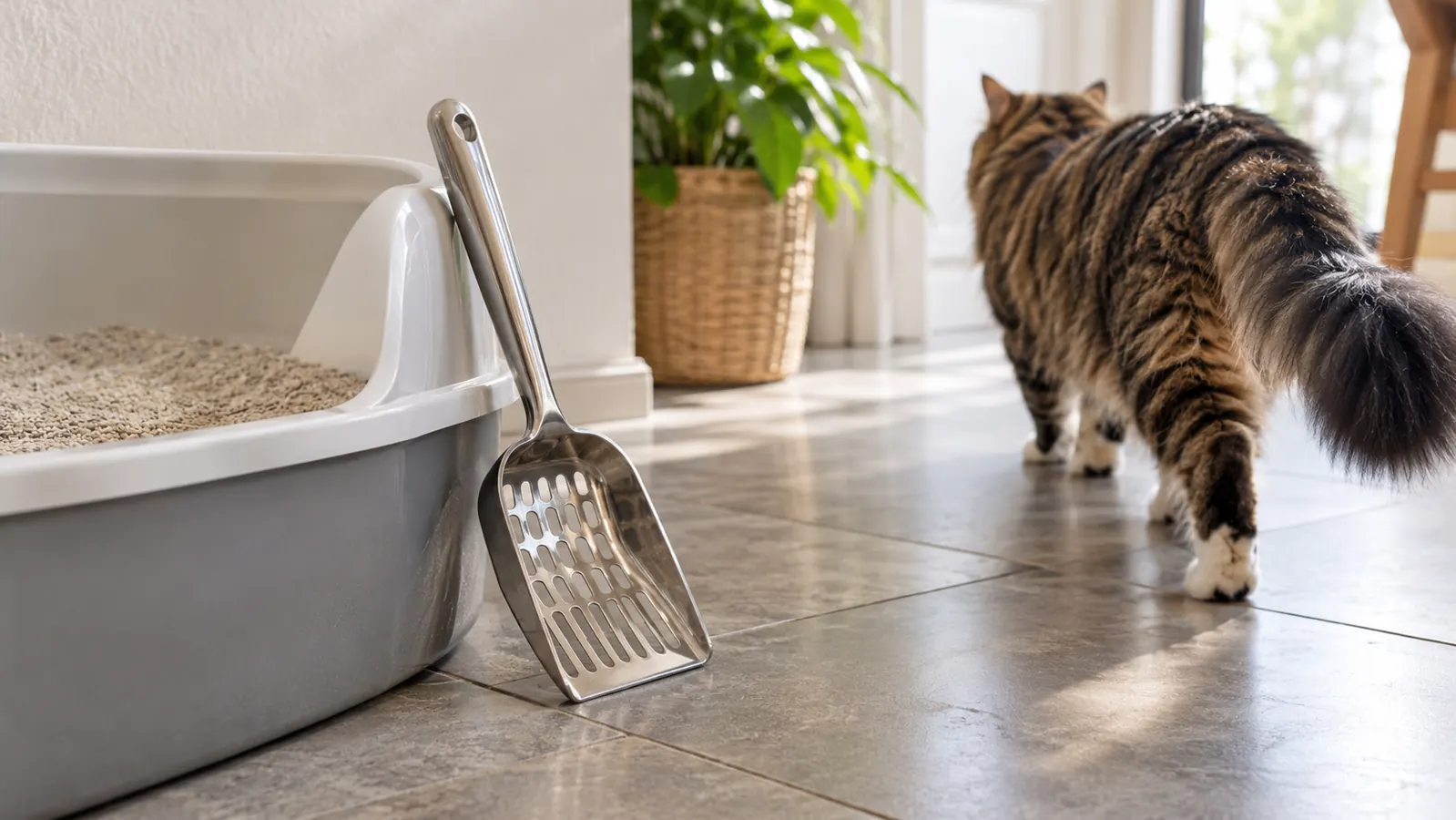
After six months, the box looks used but not worn out. The plastic has fine scratches from the scoop, mostly in the corners where I dig. The smooth interior still wipes clean, and the walls have not cracked. I have not seen any staining that a warm-water wash did not lift. I wash it once a week and scoop twice a day. That is more maintenance than some people want, but it is less than I was doing when urine was landing on the floor. I will take the trade.
The bigger change is that Barnaby seems more comfortable. He used to stand in the old box with his front paws on the rim and his back end hanging over the side. He does not do that now. He turns around, digs, and leaves. The 30-inch length gives him room to do that, and the 20-inch width gives him room to turn without stepping in his own waste. That is not a small thing for an 18-pound cat. I did not realize how much he was holding himself until I saw him use a box that fit him.
Who This Is For
This box is for people with a large cat and enough floor space. If your cat is over 15 pounds, if they hang over the edge of a standard pan, or if you are tired of sweeping litter off the floor, the IRIS USA XX-Large is worth measuring for. The listing names Maine Coons, Ragdolls, and Savannahs as the target sizes, and I would add any big domestic cat with a long body. It is also a good fit for a household with one big cat and one average cat, as long as you have room for more than one box. I have one cat, so I cannot speak to a crowd, but the size would hold up. It is a simple pan, and simple is what I want.
Who Should Skip It
Skip it if your floor space is tight. A 30 by 20 inch box is not a decoration, and it will not tuck into a corner the way a small pan will. Skip it if you have a kitten or a very small cat who would have to climb over a 14-inch wall to get out. The 6.5-inch entrance helps, but the wall is still tall. Skip it if you want a covered box or a box with a filter. This is an open pan. And skip it if you are not willing to scoop twice a day. No box, large or small, fixes a dirty litter routine.
A Few Details That Matter More Than They Sound
The 6.5-inch entrance sounds like a small detail until you watch a big cat use it. Barnaby does not have to lift his front paws high or duck his head. He walks in. The curve means there is no sharp corner catching his hip. If your cat is older or a little stiff, that matters. I would not call this a box for a cat with serious mobility problems. I would call it a box that is easier to enter than a tall pan with a straight lip. If your cat is struggling, ask your vet first and keep a lower option nearby.
The 14-inch wall is the other detail. It is tall enough to stop litter from flying, but not so tall that I cannot see inside. I can stand at the washer and glance over to see whether the box needs scooping. That sounds lazy, but it is practical. A covered box hides the mess until it is a bigger mess. An open box lets you see it. The trade is odor. I would rather see it and scoop it than hide it and forget it. That is the whole reason I went back to an open pan.
If your cat hangs over the edge, start with the measurements
The IRIS USA XX-Large pan gives a big cat room to turn and a tall wall to keep litter in. Measure your floor space, then decide.
Amazon Check Today's Price on Amazon →