
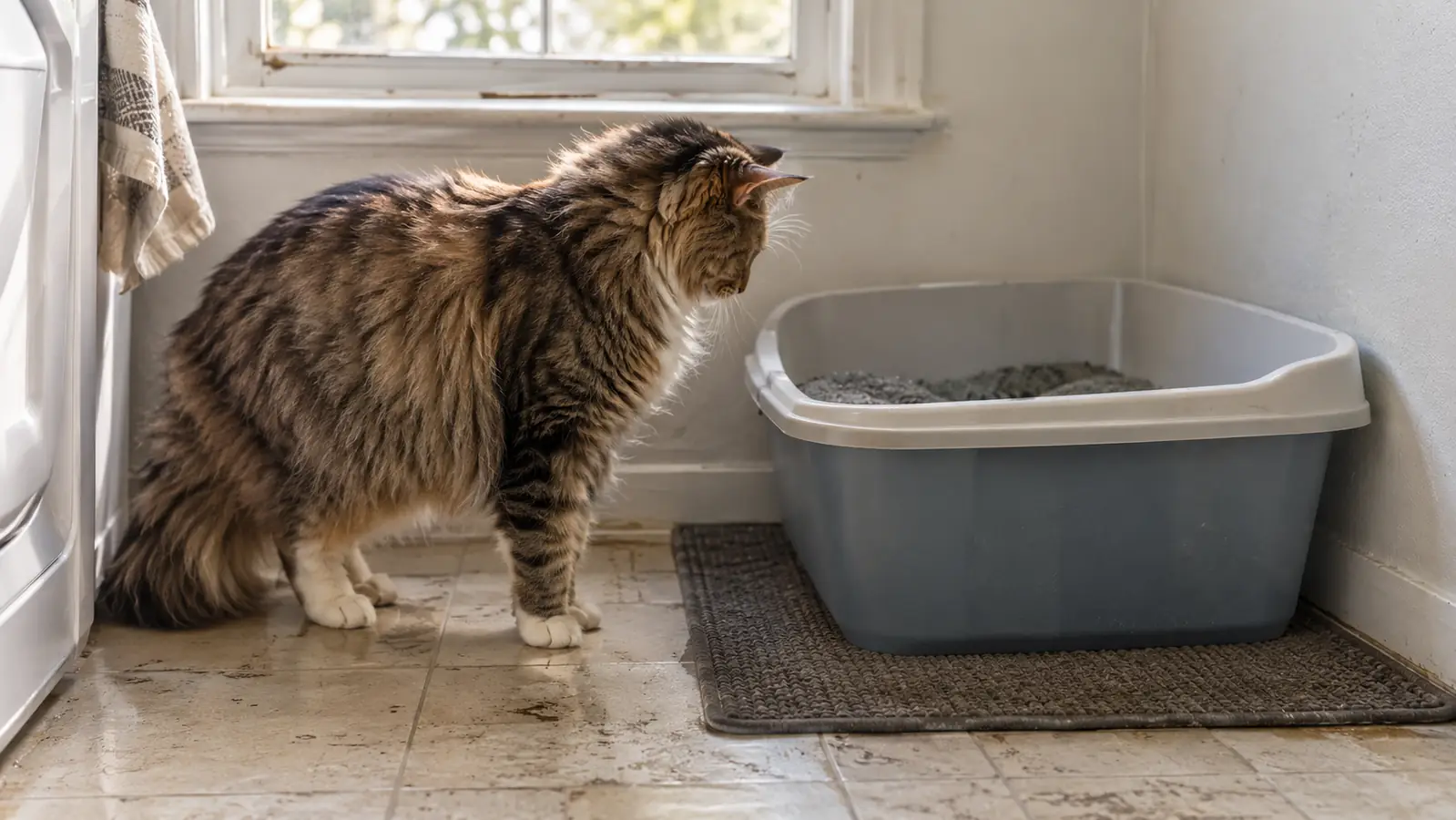
The litter on my bathroom floor was not Barnaby's fault, and it took me about a year to admit that. He is an 18 pound Maine Coon with long britches that hold onto clay granules the way a mitten holds onto lint, and he was doing exactly what a cat does when he climbs out of a shallow pan. He was launching himself. The old box had low walls, so every exit threw a small spray across the tile, and every morning I swept it up and told myself that was just life with a big cat.
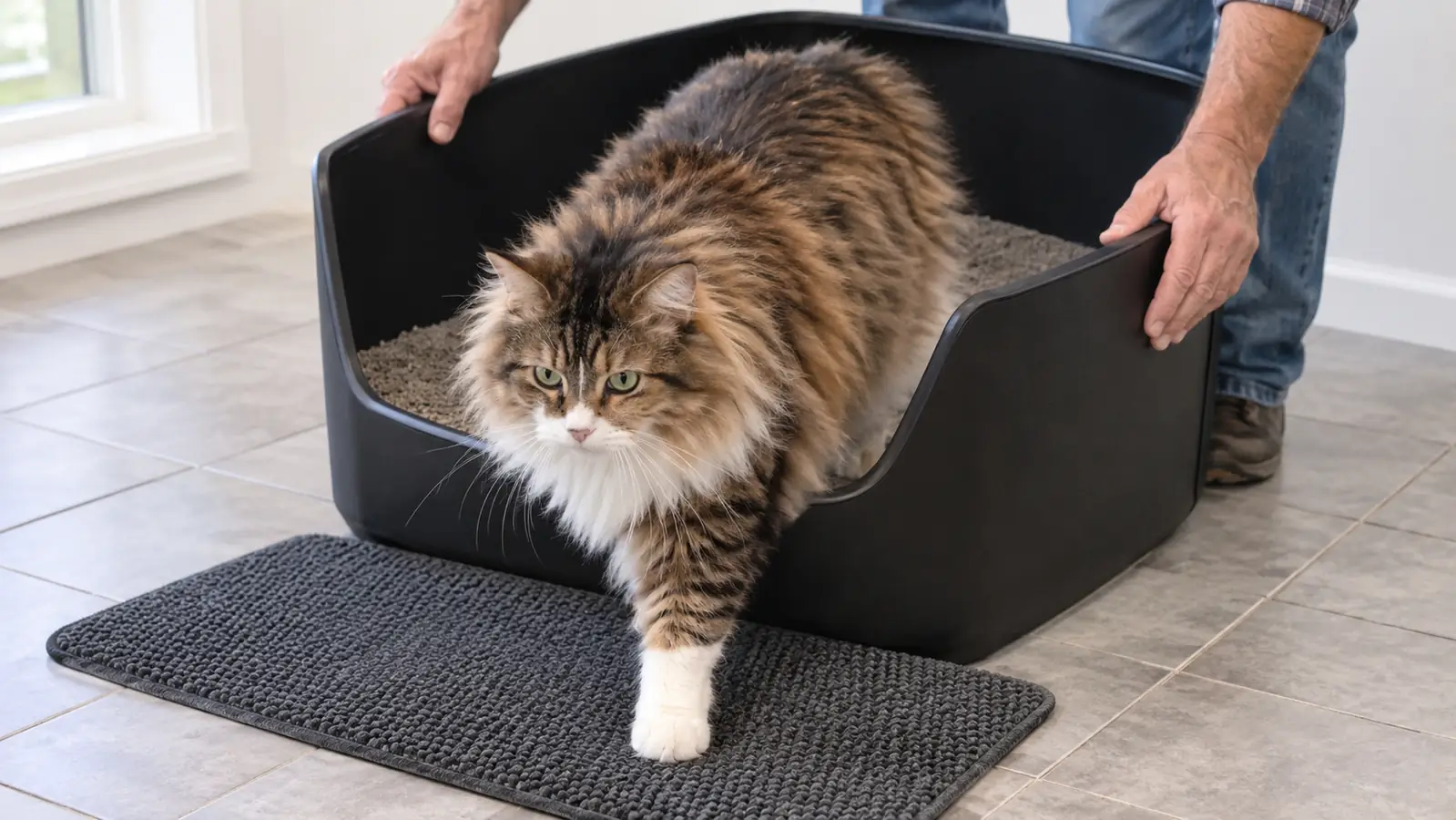
A high sided box does not teach your cat to be tidier. It changes the physics of getting out. When the walls are tall enough that he has to step down through an opening instead of clearing a rim, most of what is stuck to his feet stays in the pan. The one I use now is the IRIS USA XX-Large High Sided Cat Litter Box, which measures 30 inches long, 20 inches wide and 14 inches tall. That is a genuinely big pan, and the 14 inch walls are the entire point. It also has a 6.5 inch curved entrance, so Barnaby steps down through the dip in the front instead of vaulting a wall.
The walls are the fix, not a bigger scoop
IRIS USA builds this pan at 30 inches by 20 inches with 14 inch walls and a 6.5 inch curved entrance, so a big cat steps out instead of launching. If your floor looks the way mine did, start here.
Amazon Check Today's Price on Amazon →Why Scatter Happens in the First Place
Three things cause it, and only one of them is the cat. The first is wall height. A pan with 5 or 6 inch sides lets a cat clear the rim with a hop, and whatever is between his toes takes the trip with him. The second is litter depth. An overfilled box pushes litter over the edge with every dig, and a cat that digs hard can move a surprising amount of weight in a few seconds flat. The third is the exit itself.
That third one is the part people miss. Cats do not walk out of a litter box. They push off the litter and land outside it. So everything stuck to the back feet, everything caught in the fur behind the legs, all of it leaves the box in one motion. Once I understood that, my problem stopped looking like a training issue and started looking like a setup issue, which is a much easier thing to solve on a Tuesday morning.
The Five Steps That Actually Work
Step 1: Measure the Floor Before You Buy Anything
A 30 by 20 inch pan sounds manageable right up until you set it down in the room. Add the landing zone in front, where the cat comes out, and you are really using close to 30 by 30 inches of floor. In my little bathroom that meant moving the wastebasket and giving up the spot where the hamper used to live. I measured first, and I am glad I did, because I had been picturing something smaller.
Measure the wall, not the room. You want one long side flush against a wall and the entrance facing open floor, with at least two feet of clear tile in front of it. If the entrance points at a wall or a door frame, the cat has to turn as he comes out, and turning is exactly when litter flies sideways instead of dropping.
Lift the empty pan once before you commit to it. The IRIS USA pan weighs 4.3 pounds with nothing in it, and once it is full of litter it becomes a two hand object that you carry to the tub to scrub every couple of weeks. If you cannot manage that carry comfortably, a smaller pan you can actually clean is a better box than a big one you avoid cleaning.
Step 2: Put It Against a Wall, On a Mat, Facing Open Floor
The wall does two jobs. It stops the pan from sliding when a big cat pushes off the side, and it catches part of what comes over the top when he digs. Push the long side against the wall, not the short side, and leave the curved opening pointing at open floor. I put mine against the outside wall of the bathroom, where the tile is level and the door does not swing into it.
The mat goes in front of the entrance, not under the whole pan. A textured mat about two feet wide gives him two or three steps to shed granules before he reaches bare floor. I use a cheap waffle mat and shake it into the trash every other morning. It is not elegant, it cost very little, and it catches more than any fancy tray I have tried.
One thing to check once it is in place. The IRIS USA box is an open top pan, and it needs to stay that way. Do not build it into a cupboard or slide it under a shelf that covers the top. Air moving over the litter is what keeps a small room from smelling like a small room, and you also want to be able to look in and see at a glance whether it needs scooping.
Step 3: Get the Litter Depth and Litter Type Right
Two to three inches of litter is where I have landed after a lot of trial. Deeper than that and Barnaby shoves it over the entrance when he digs. Shallower than that and he scrapes the bottom of the pan, which makes a hollow noise he does not care for and does nothing at all for odor.
Litter type matters more than I expected. Fine, light clumping litter tracks like sand. It works into long fur and it travels across a room. A heavier, coarser clumping litter stays in the pan better, and with my cat the difference was obvious within a week. Pellet litters scatter the least of anything I have tried, but not every cat will use them and mine would not, so we compromised on the coarse clumping kind.
Fill the pan before you set the bag down, because a 14 inch wall looks bottomless and it is easy to overfill. I put a strip of tape on the outside of the pan at the depth I want, and now I fill to the tape instead of guessing. Small thing, but it stopped me from repeating the same mistake every time I topped up.
Step 4: Watch How Your Cat Actually Exits
Spend five minutes watching, ideally from across the room so you do not distract him. Most cats will use the curved entrance, step down through the dip, and land on the mat. Some will climb the wall anyway, and those cats need the mat moved to wherever they land rather than wherever the door is.
If your cat is starting to slow down, the entrance height is worth a thought. Barnaby has gotten careful about jumping onto my bed in the last year or so, and that was on my mind when I chose this box. The 6.5 inch lip is low enough that he walks out rather than hops, which is easier on an older cat than a tall rim he has to clear. If your cat is stiffer than that, ask your vet before you change anything, because a box that is hard to get into is a box he may start avoiding.
And if he is coming out over the top no matter what, turn the box. Cats pick an exit and stick with it. Put the mat where he actually lands, not where you think he should land, and stop arguing with him about it. I lost that argument for months.
Step 5: Make the Daily Sweep a Two Minute Job
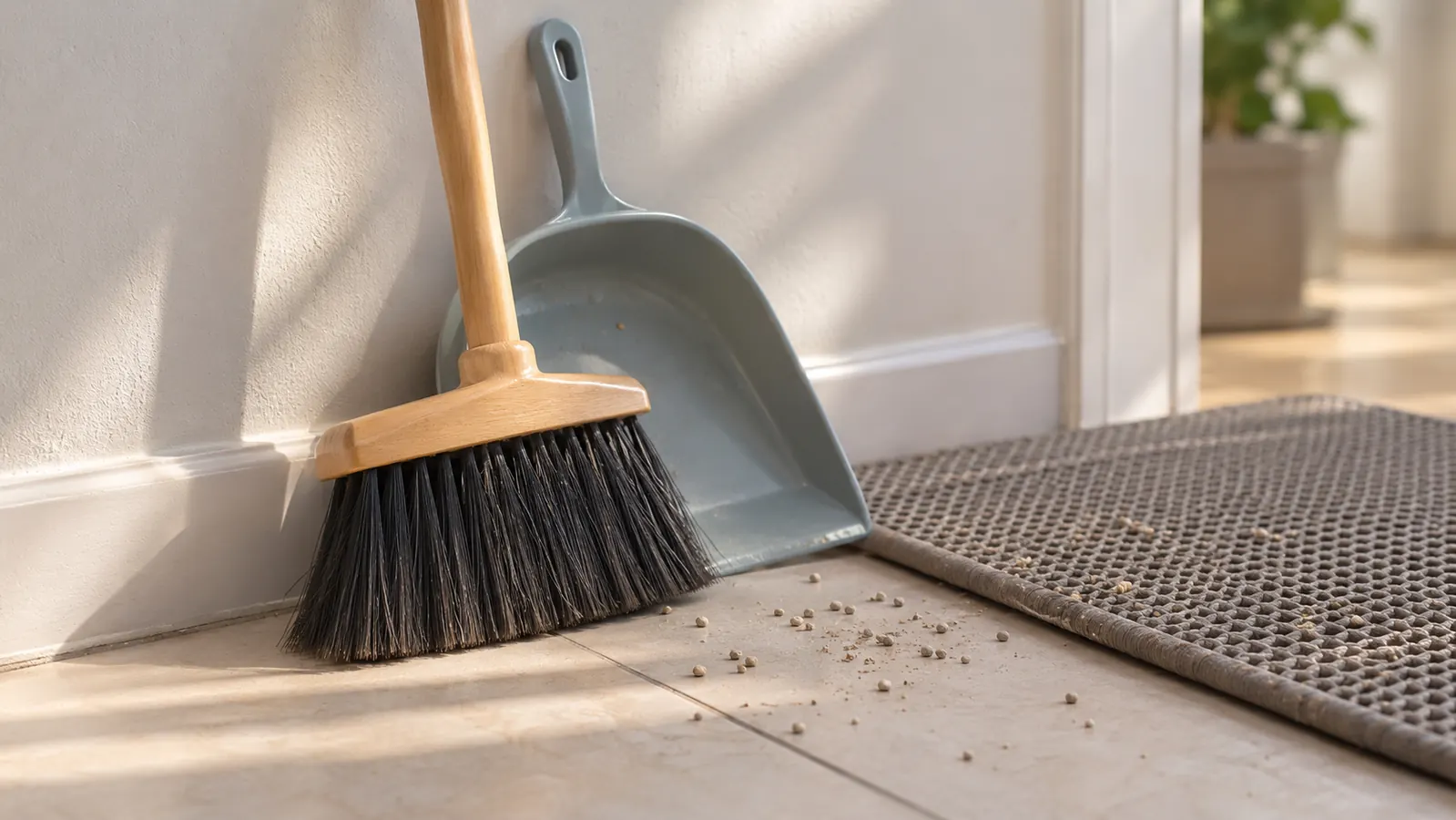
The box does most of the work, but the floor still needs a pass. I keep a small hand broom and dustpan beside the pan and sweep the mat area every morning while the coffee brews. Two minutes, start to finish. If it is taking longer than that, something in the setup still needs adjusting.
Scoop twice a day, once in the morning and once before bed. Wipe the inside down once a week with unscented soap and warm water. The interior of the IRIS USA pan is smooth with very few seams, so a wipe down takes about as long as washing a dinner plate. My last box had a rim and a lip and a pebbled texture that caught clay in every corner, and I do not miss scraping it out with a plastic fork.
Do a full litter change on a schedule rather than waiting until it looks bad. With one cat I dump and refill every three weeks and top up in between. More cats, or a cat this size, means more often. A clean pan is also a pan a cat keeps using, and a cat who keeps using his box is the only real defense against scatter you cannot sweep.
What Else Helps
Grooming is half of this, honestly. Barnaby's britches mat if I skip a week, and the fur behind his back legs is exactly where litter rides out of the box. A five minute brush most days, plus a sanitary trim every few weeks, cut the scatter in my house noticeably, and it did more for the matting than any product I have bought. He tolerates the brush and he does not tolerate the clippers, so I do the trim in short sessions with a treat between each one.
Two more things that cost nothing. Keep the box in the same spot. Cats learn a route in and a route out, and moving the pan resets the mess for a couple of weeks while they relearn it. And if your cat suddenly starts urinating outside the box, that is a vet question, not a litter question. Litter on the floor is an annoyance. A cat avoiding his box is a health sign, and our vet is the person to ask about it.
Cats do not walk out of a litter box. They push off the litter and land outside it. Once I understood that, the answer was taller walls, not a better behaved cat.
How Long Before the Floor Stays Clean
Not overnight, but faster than I expected. The first week with the taller pan I still swept every morning, out of habit more than need. By the second week the daily pile was a sprinkle instead of a scatter, and by the third week I was sweeping every other day and the mat was catching nearly all of it. The granules that used to travel three feet from the box now stop at the mat.
What did not change was the fur. Nothing about a taller wall stops a long haired cat from carrying litter in his britches, which is why the brush matters as much as the box. If you take only one thing from this, take the combination: a pan with walls he cannot clear, litter at the right depth, and a brush a few times a week. Each one helps, and together they ended the daily sweep for me.
Who This Box Suits, and Who Should Skip It
It suits large cats and long haired cats first. Maine Coons, Ragdolls, big domestic shorthairs, any cat that fills a standard pan and then some. It suits hard diggers like mine, and it suits anyone with a corner of a laundry room or bathroom to give up. The IRIS USA pan measures 30 by 20 inches and that footprint is the trade. It is a great deal of pan, and there is no version of this that does not take up floor space.
Skip it if you have a kitten or a small cat who would be more comfortable in a smaller box, or if you truly do not have room in front for a landing zone. Skip it if your cat is unsteady on his feet, because a 6.5 inch step is still a step and there are pans with a lower entry. And skip it if you want a covered box. This is an open top pan and it is not pretending to be anything else, which is part of why I like it.
If the floor is still the problem, the walls probably are too
IRIS USA gives you 30 inches by 20 inches of pan, 14 inch walls, a 6.5 inch curved entrance, and a smooth interior that wipes clean in about a minute. That is the whole idea, and it is the one change that ended my morning sweep.
Amazon See the IRIS USA XX-Large on Amazon →