
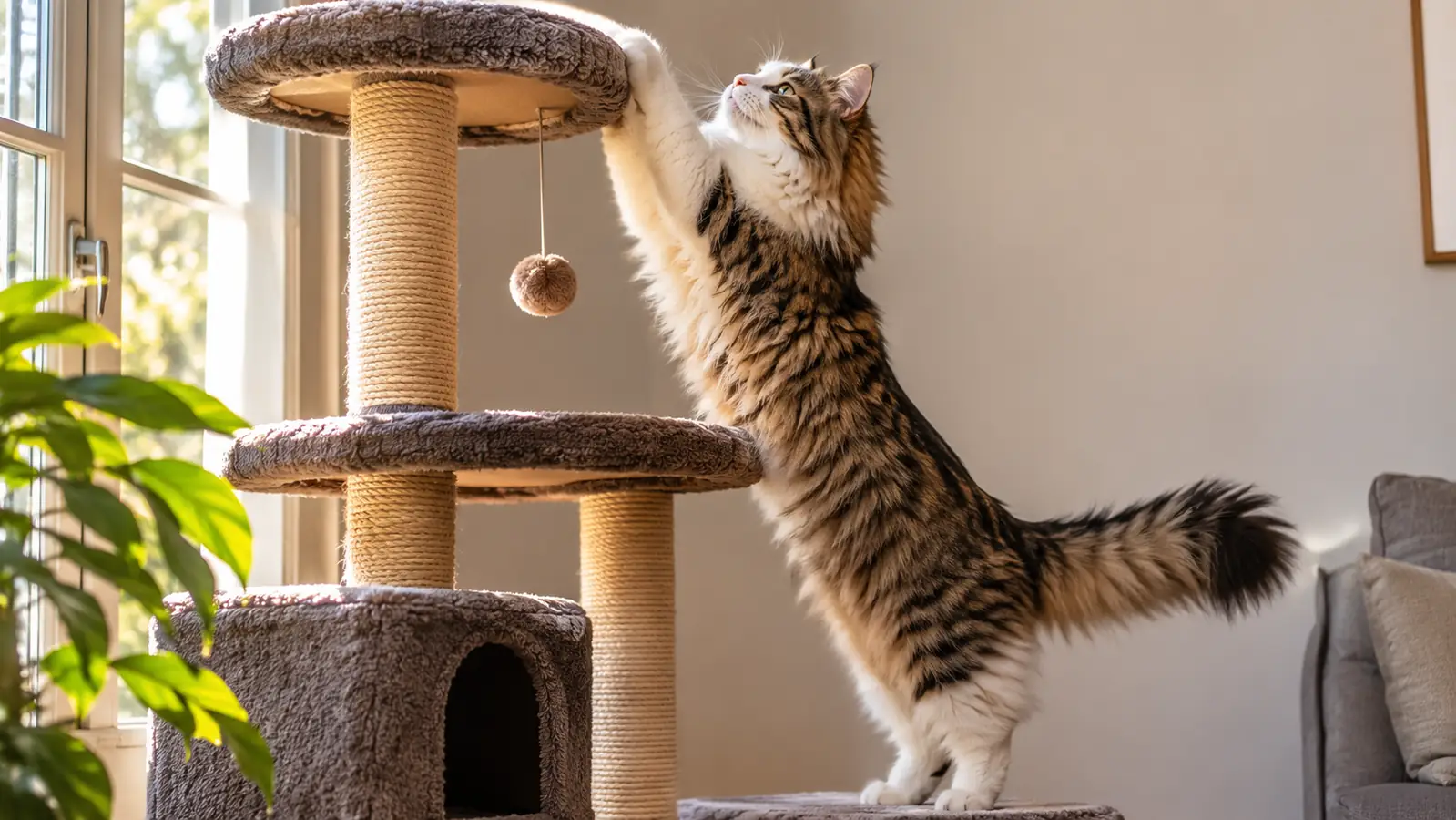
The first time I caught Barnaby working over the arm of a chair I have owned since 1994, I did what most people do. I clapped, said his name in the Voice, and felt briefly like I had handled it. He blinked at me with the mild disappointment of a cat who has been interrupted at his job, waited until I went into the kitchen, and went straight back to it. Three weeks later the fabric was open and the batting was coming out in tufts.
Scratching is not a behavior problem, and that is the first thing worth knowing. It is a need that comes with the cat. He scratches to work the old husks off his claws, to stretch his shoulders all the way out, and to leave his scent on things so the house smells like him instead of like a stranger with a mop. You are not going to train it out of an 18 pound Maine Coon. What you can do is give him somewhere better to do it and make that somewhere worth his time. For us the somewhere is the Yaheetech 63in sturdy large cat tree, but I want to be honest with you: the tree was half the job. The other half was me changing where I put things and how I reacted. Here is the order that worked.
The only piece of furniture in this house Barnaby is allowed to ruin
63 inches tall, six levels, and a base wide enough that it does not shift when an 18 pound cat throws himself at the top of it. This is what ended the argument with my chair.
Amazon Check Today's Price on Amazon →Step 1: Find the Spots He Has Already Chosen
Do not start by shopping. Start by walking the rooms with a pencil and looking at damage you have been walking past for months. Two things matter. The first is height: get down on your knees and see how far up the marks go. A cat that leaves a long vertical stripe from the baseboard up to hip height is a cat looking for a full stretch, and a short post is never going to satisfy him. The second is direction. Vertical marks on a chair arm, a door frame, or the corner of the sofa mean one thing. Horizontal marks raked across the carpet mean something else, and you will want a flat scratcher for those as well as the tree.
Barnaby's marks were all vertical and all high, six or seven inches above the arm of the chair, which told me he was trying to stretch the whole length of himself and the chair would not let him. That single detail was worth more than everything I read online that spring. Find your cat's version of it.
Write down the top three spots, room by room. Those three are the real estate. When you decide where the tree goes, it goes beside one of them, not into the corner of a room the cat only visits when the grandkids are chasing him.
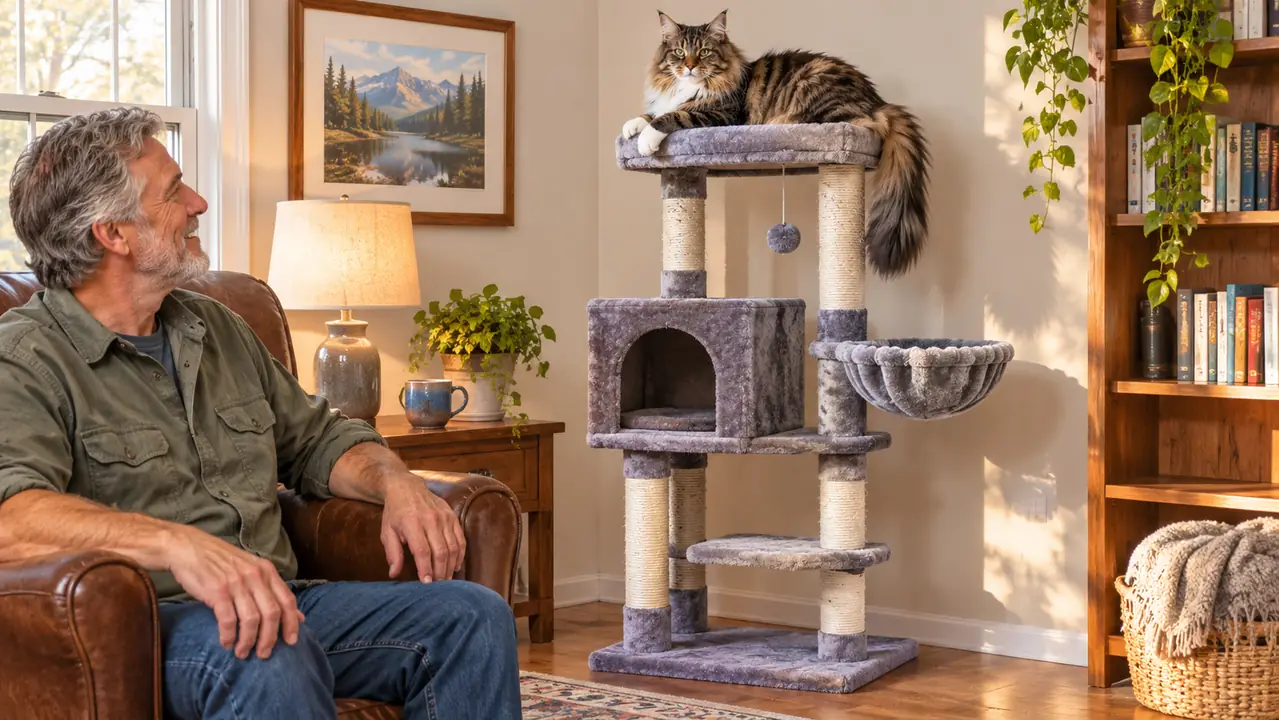
Step 2: Put the Tree Where He Already Scratches
Cats scratch where they live. Near where they sleep, near where the people are, near the doors and windows they patrol. A cat tree in a cool spare bedroom is a tree that will look brand new in five years. I have made this mistake. Ours started behind the woodstove because it looked tidy there and did not block the light, and Barnaby ignored it for a month while continuing to work on the chair.
Then I moved it beside the window on the porch side, where he watches birds in the morning, and the change took about a week. He was on the foam-edged perch, which is 21 by 15 inches, before I had finished deciding whether that was where I wanted it. The footprint is 30.5 by 19 inches, so it fits behind a chair or into a bay window corner without eating the room. For the first two weeks I set it slightly in front of the chair he was ruining, close enough that turning around meant meeting the tree. After that I moved it back a foot and he followed it.
If you have a one-story house like mine, do not try to cover the whole place with one tree. Put it where the cat actually spends his day. Barnaby's day is the porch window in the morning and the living room in the evening, and the tree sits where those two overlap.
Step 3: Make It Steady Enough That He Trusts It
A cat will not throw himself at something that moves under him. Every time I have seen a cat ignore a perfectly good tree, the reason was wobble. The Yaheetech tree is 33.7 pounds on a wide base, and it still ships with an anti-toppling kit and a reinforced washer, and I want you to install that kit rather than leave it in the bag. Ours is against the wall by the window, strapped the way the instructions show. It has not shifted once, including the night Barnaby came down the outside of it at speed because the doorbell rang.
Assembly is a Sunday afternoon job, not a weekend. The manual is illustrated, the parts are labeled, and the tools are in the box, so one person can do it alone, which I did at the kitchen table with the radio on. Check the screws after the first week and again after the first month. New furniture settles, and a loose bolt is a wobble, and a wobble is a cat who goes back to the chair.
The tree is 63 inches tall with six levels and five platforms. That matters more than it sounds. Barnaby is a tall cat who wants to be high up, and height is the part of the deal he actually cares about. There is a condo rated for up to 22 pounds and a hammock rated to 18 pounds, and I will tell you plainly that he is right at the edge on that hammock at 18 pounds. He uses it. I check it every couple of weeks. If your cat is bigger than Barnaby, that is a data point worth having before you buy, and the three year manufacturer warranty is the reason I did not worry much about it.
Thirty three pounds of tree on a base 30.5 inches by 19 does not tip when an 18 pound cat launches at the top platform. That is the only reason he trusts it, and a cat who does not trust a tree will not use it.
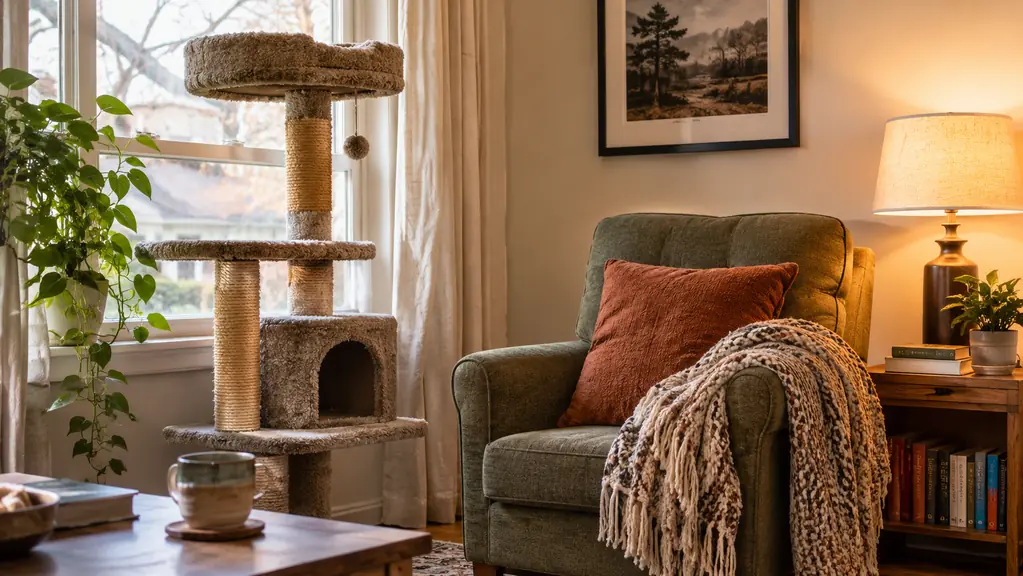
Step 4: Move Him to the Tree, Not Just Off the Couch
The instinct is to punish, and I understand it, because I have done it. Spray bottles, loud noises, the hand clap. Here is the problem with all of it: the cat learns to scratch when you are not in the room, which is most of the time, and he learns nothing about where he should be scratching instead. What worked for me was dull and consistent. When I caught him at the chair, I picked him up without much drama, set him on the lowest platform, and ran my own fingernails down the post a few times so he could hear it. Then I walked away. No lecture. Ten seconds of attention is a reward to a cat, and I did not want to reward the chair.
The other half of that was making the tree the place where good things happen. A wand toy dragged up the side of it gets a cat climbing. A treat set on the perch means the perch is worth visiting. Barnaby is not food motivated, so for him it was the toy, and it was me sitting nearby in the evening instead of across the room. Your cat will have his own currency.
One thing I will say plainly, because I have been asked about it. Declawing is not a solution I would consider. It is an amputation of the last joint of each toe, and it can change how a cat walks and how he uses a litter box for the rest of his life. If someone is pushing you toward it, get a second opinion first. Giving the cat a better place to scratch costs less in every way.
Step 5: Protect the Weak Spots and Keep the Routine
While the new habit sets in, make the old spot less interesting. A tightly woven throw over the arm of the chair helps, because the texture does not give him the resistance he wants. So does a slipcover, and so does double sided tape on the corner he favors, though tape needs replacing and it looks strange to guests. I used a throw for about six weeks and then took it off.
Nails matter more than people expect. I trim Barnaby's front claws every two weeks, tips only, nowhere near the quick, and a vet tech showed me how once so I would stop worrying about it. Shorter nails mean less damage per stroke while he is learning, and they mean he is less likely to catch a claw in the upholstery and pull a thread. If your cat's nails are dark and you cannot see the quick, have someone show you the first time.
Then keep the tree where it is. I know that sounds trivial. Moving it because company is coming is exactly how a good habit falls apart. The tree stays by the window, the chair stays covered a few more weeks, and the whole business becomes boring, which is the goal.
What Else Helps
More than one place to scratch beats one perfect place. Barnaby has the tall tree by the window and a flat cardboard scratcher in the hall where he waits for me in the morning, and the two of them together did more than either one alone. A second small scratcher near the bed is a cheap thing to try if the bed frame has been taking a beating. I also brush Barnaby a couple of times a week, which has nothing to do with scratching and everything to do with the mats that form behind his back legs if I skip it.
The other thing I would tell a friend is to watch how your cat moves. Barnaby had started hesitating before jumping onto the bed, which is ordinary for an 8 year old cat of his size and also the kind of thing worth mentioning to the vet rather than guessing about. Ours had a look at him and gave me sensible advice about keeping his jumping surfaces low and steady, which is one more reason the Yaheetech tree has been good for him. Anything about how your cat walks, jumps, or holds his back is a question for your vet, not for me. And if the tree has not worked after two months of honest effort, the fix is almost always placement, not a different tree.
If your cat has already picked his spot, put the tree next to it
63 inches, six levels, a base that stays where you put it, and a hammock for the cat who likes to hang. This is the one my chair survived. Measure the corner first and check today's price.
Amazon Check Today's Price on Amazon →