
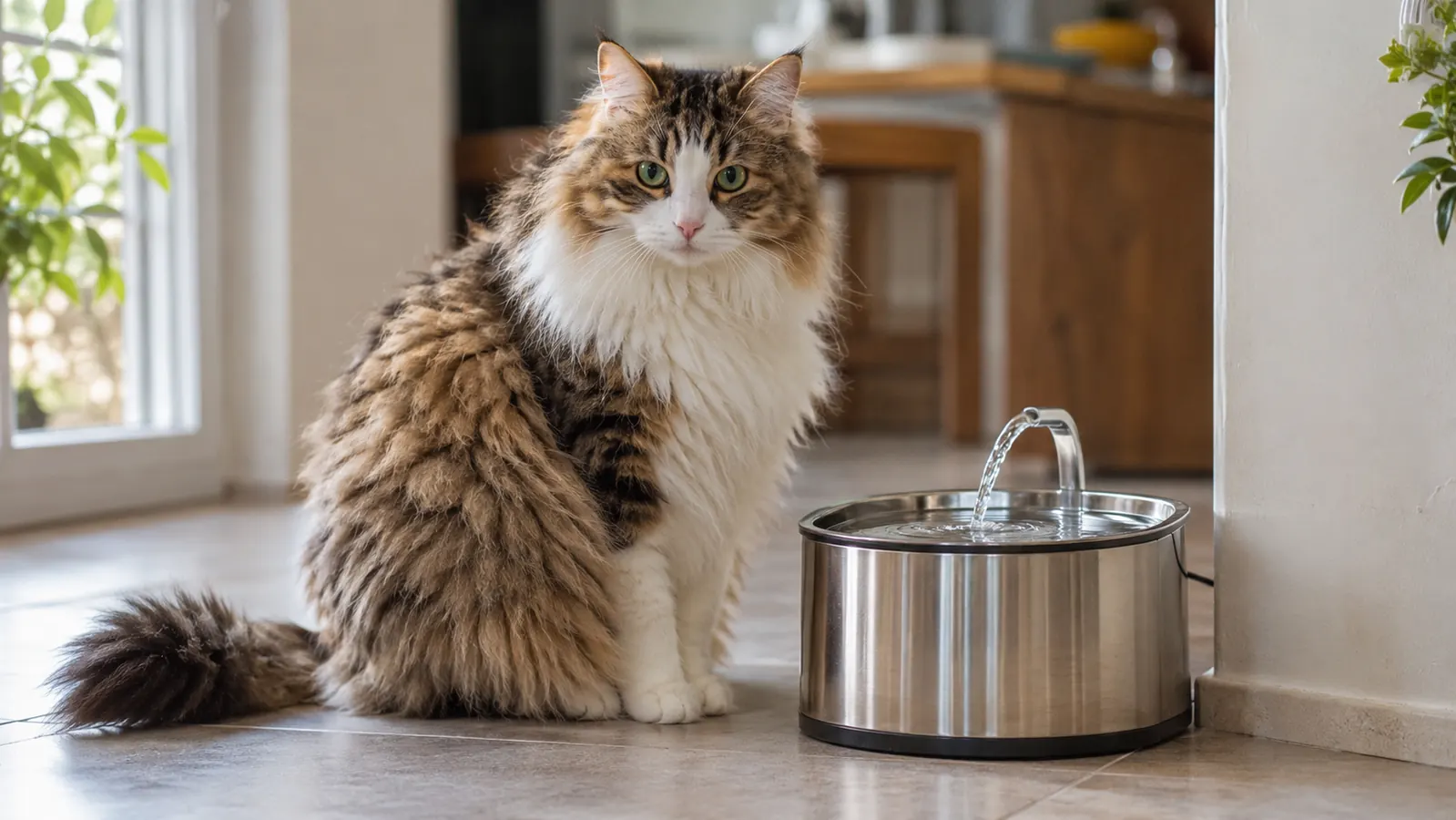
Barnaby drinks like a cat with somewhere better to be. Two licks, a long look at the ceiling, and he is gone. For years I refilled the same ceramic bowl twice a day and told myself he would drink when he was thirsty. That is the advice everyone gives, and for a young cat in good health it is mostly true. For an 18-pound Maine Coon with a thick ruff and a long shaggy coat, it is worth paying closer attention than that. Cats come from desert stock, their thirst drive is quiet, and a cat can run short on water for a long while without anyone noticing anything except a litter box that looks a little different.
What changed things in this house was not a clever trick. It was moving water. A cat's instinct says that still water sitting in the same spot all day has been sitting there a while, while moving water is fresh. That one piece of cat logic is the whole reason fountains work, and it is why a Neareal stainless steel fountain ended up on my kitchen floor, all 108 ounces of it. I have run it long enough now to know which parts of the routine matter and which parts are just noise printed on the box. Here is the order I would do it in if I were starting over.
The Fountain That Ended My Twice-a-Day Bowl Refill
108 ounces of 304 stainless steel, a pump that keeps the surface moving so the water reads as fresh, and a basin that lifts off the base for washing. It ships with four filters and four sponges and carries an 18 month warranty.
Amazon Check Today's Price on Amazon →Step 1: Put It Where the Cat Already Walks, Near an Outlet
Start with a room the cat is already in. Cats do not cross a cold kitchen floor for a drink. They drink from whatever is on the way to wherever they were going. Barnaby's route runs from the screened porch to the foot of my bed, with a stop in the kitchen doorway to check whether I have dropped anything interesting. That doorway is where the fountain sits, against the wall, and I think it is the single biggest reason this worked at all.
I tried the bathroom first, because that is where the old bowl had lived for years and I thought familiar would beat convenient. It sat on the tile for four days and Barnaby drank from it exactly once, at two in the morning, when I happened to be up anyway. The bathroom is a dead end with the door half shut and a cold floor, and a cat wants a way out of a room before he wants a drink in it. Once I moved the fountain to the kitchen doorway he was at it inside a day. Position beat every other thing I tried.
The catch is the cord. This is a corded fountain, 5 volts, so the spot has to be within reach of an outlet. Mine sits about a foot off the baseboard with the slack coiled behind it where nobody steps. Do not run an extension cord across a walkway. I know that sounds like the most obvious sentence ever written, but I have grandchildren who visit on Sundays, and water plus a loose cord on a kitchen floor is not something to be casual about.
One more thing about placement. Do not tuck it into a closed alcove where the cat has to be cornered to drink. Cats want an exit. A wall with one open side is fine. A dead-end cupboard is not, no matter how nicely the fountain fits there.
Step 2: Leave the Old Bowl Out for a Week or Two
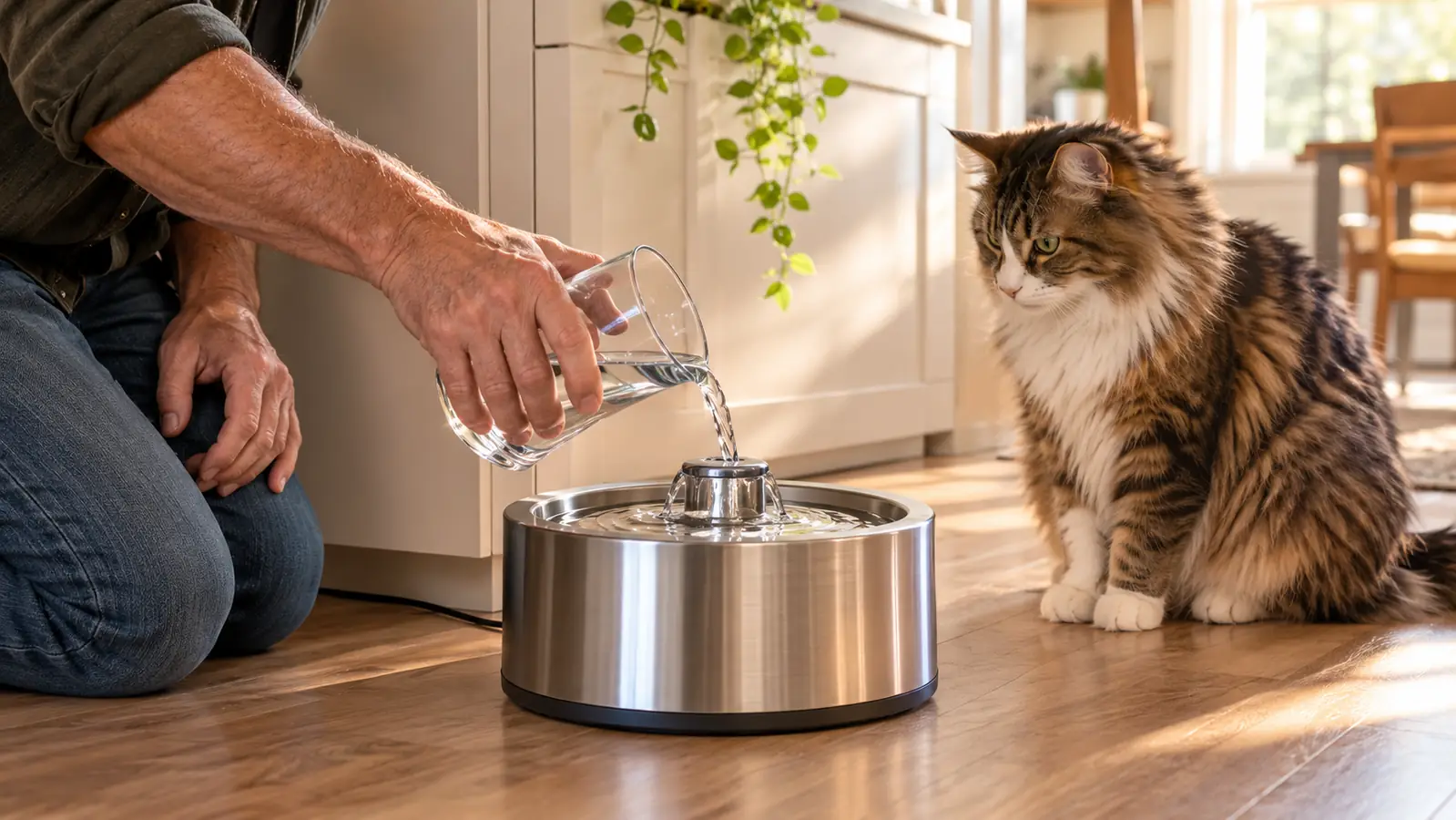
Two water sources is not a failure. It is how you avoid a cat who decides the new thing is suspicious and drinks less than he did before you spent the money. Put the fountain down, keep the old bowl exactly where it was, and then go do something else.
The first two days Barnaby ignored it completely. On the third day he sat three feet away and stared at the moving water. On the fifth day he put one paw on the rim and took it back. I did nothing during any of that. The strong temptation with a nervous animal is to carry it over and hold it near the fountain, and that teaches a cat exactly one lesson, which is that you are going to grab him near water.
I marked the days on the kitchen calendar so I would stop second-guessing myself. Day six he had both front paws on the rim with his head down, actually drinking, and he startled himself when the water burped. Day nine I caught him walking over to it unprompted, which is the morning I finally relaxed about the whole purchase. Nine days, not nine minutes. If you are on day three and convinced you have wasted your money, you are exactly on schedule and the only thing left to do is leave him alone with it.
If your cat is more stubborn, put a saucer of water on the floor beside the fountain and move it a few inches closer every week. Same water, same corner, until the cat is drinking right next to the moving water instead of avoiding it. I retired the ceramic bowl once Barnaby was clearly using the fountain most days, though I still keep a plain bowl of standing water on the screened porch in summer, because he spends half of July out there.
Step 3: Keep It Full and Keep It Clean
108 ounces is a lot of water for one cat, and that is the point. I fill it in the morning, top it off before bed, and the pump is never pulling air. A fountain that runs low gets loud and stays loud. Mine sits on a hard floor, so I hear the change. When the sound goes from a soft trickle to a splashing rattle, the level has dropped and it needs water. Capacity does not save you here. The pump needs water above it, whichever model you buy.
Cleaning is the part that decides whether a cat keeps trusting the thing. I take the basin off the base and wash it in hot soapy water twice a week, and I run the stainless parts under the hottest tap water I have. That is where 304 stainless steel earns its keep. My old ceramic bowl had a hairline crack in the glaze that I could feel with a fingernail and never could get properly clean, and stainless does not do that.
Once a month I unplug the whole thing and rinse the pump under the tap, working a finger around the intake where the hair collects. Barnaby has a coat that sheds in handfuls twice a year, and I have pulled a felted wad of it out of that intake more than once. A fountain with hair packed around the water intake gets noisy and then gets quiet in the wrong way. It is a five-minute job with a paper towel, and it is the difference between a fountain that lasts and one that goes in the bin in March.
The Neareal comes with four filters and four sponges, which tells you the maker expects you to change them on a schedule, so follow the schedule that comes in the box rather than inventing your own. The fountain uses a quadruple filtration setup, a stack of layers the water passes through before it goes back over the top. Rinse the sponge every time you wash the basin. The sponge is the piece everyone forgets and the piece that starts to smell first.

Step 4: Do Not Rely on the Fountain Alone
A fountain is one source of water, not the only one. For a lot of cats, wet food is most of the answer. Barnaby gets half a can of pate in the morning and I mash two tablespoons of warm water into it until it looks like loose oatmeal. He licks the plate clean, and I know exactly how much water went into him, which I cannot say about anything he drinks.
I also keep a plain bowl in the bedroom. Barnaby sleeps on the bed, and he has gotten a little stiff jumping up onto it this year, so a cat who is not eager to hop down and trot to the kitchen at three in the morning has water within reach. A second still bowl costs nothing and covers the hours when the fountain is on the other side of the house.
And do not put the water right against the food dish if your cat seems uninterested. Plenty of cats prefer their water a few feet away from where they eat. Mine does not care, but my daughter's cat does, and it took her a year to figure that out.
Step 5: Track It, and Call the Vet When the Number Changes
You cannot measure what a cat drinks from a fountain, so measure the fountain. I check the level at the same time every morning before I top it off, and after a few weeks I knew roughly where it should sit. That is my baseline. When it drops faster than usual, or slower, I notice.
One week I poured a measured 16 ounces in at seven in the morning just to see how fast it went, and it was gone by supper. That taught me the level is a rough instrument and not a measurement. Some of that is evaporation, some of it is the cat, and from the outside I cannot tell the two apart. So I use the water line for the trend and the litter box for the detail. Two clumps where there used to be three is information the fountain cannot give me.
This part is not a do-it-yourself job, and I am not a vet. Our vet gave me a range for how much water an 18-pound cat ought to be taking in over a day and told me to watch the litter box as much as the bowl. Drinking noticeably more than usual, drinking noticeably less, straining in the box, or suddenly preferring the bathroom tap to the fountain are all reasons to pick up the phone. A change in thirst in an 8-year-old cat is a reason for bloodwork, not a reason to buy a bigger fountain.
What Else Helps
Water temperature matters more than I expected. Barnaby turns his nose up at water that has been sitting in a warm room all afternoon. Dumping the basin and refilling it with cool water every couple of days, rather than just topping it off, keeps it palatable. The moving surface helps, but it does not make stale water fresh.
Watch the bowl width if your cat has a heavy ruff. A big cat with a thick chest ruff and long whiskers does not like putting his face into a narrow dish, and some cats will drink less rather than press their whiskers against the sides. The oval shape of this fountain gives a wide surface to lap from, which suits a cat Barnaby's size better than the tall narrow ceramic thing I had before.
Finally, keep an eye on his mouth. A cat with a sore tooth or a bit of gum trouble drinks less, and it looks like fussiness rather than pain. If a cat who used to use the fountain stops and nothing about the placement or the cleaning has changed, have his teeth looked at before you buy a second fountain. I learned that one the expensive way with a previous cat.
Two licks and a look at the ceiling turned into thirty seconds at the fountain every morning while the coffee runs. Same cat, same kitchen, different water.
None of this is complicated, and none of it happened quickly. It took about three weeks from the day I plugged the thing in to the day I put the old ceramic bowl in the cupboard. What made the difference was not a gadget doing something clever. It was putting moving water on the path a cat already walks, keeping it clean enough that he trusts it, and paying attention to the level so I would know if something changed.
If You Are Going to Try One Thing, Try Moving Water
The Neareal holds 108 ounces, runs on a 5 volt cord, and comes apart for washing so the basin actually gets cleaned instead of just rinsed. Four filters and four sponges are in the box to get you started.
Amazon See the Current Price on Amazon →